I’ve been on HRT for over two years now, and the effect feels simultaneously mundane and like the biggest miracle in the world. It’s mundane because I’m literally just a woman now – a typical lefty Melburnian lady in her 30s with cabbage in her granny trolley – and it’s a miracle because the entire psychic and material structure of patriarchy trained me to think this was impossible. The mundanity is the miracle, in a way. The miracle is that you can just do this. You can, in most of the important ways, change your sex. It’s no big deal. It’s the most incredible thing in the world and it’s no big deal.
One of the more distinctive aspects of my transition narrative – at least in comparison to the dominant one – is that I genuinely didn’t know that I wanted to be a woman before starting to take estrogen. I didn’t have a childhood full of private certainty and unmistakable signs. I knew that I had ‘some gender stuff going on’, that my relationship to my body was foggy and alienated, and that I had always felt powerfully drawn to lesbian relationships in a way that made me feel deeply ashamed … but I had lots of other potential explanations for all those things. (Frankly, my brain could not stop coming up with other potential explanations. I was an alternative-hypothesis machine.) It was only when I started HRT – in an incredibly self-conscious ‘as an experiment, to see what it might do for me’ posture – that things became clarified.
In other words: I’m a particularly marginal kind of trans person. I’m the kind of trans person you get when society makes it easier to be trans, but who would almost certainly have turtled up into my shell in most previous eras when it was a harder thing to think and to be. I read Vivian Blaxell’s Worthy of the Event recently, and a thought I had annoyingly often (I’m sure she would be annoyed by it) was, ‘Oh God, I would not have been strong enough to transition back then.’ I would have just lived a to-all-appearances cisgender life with a hole at the center of it. In different eras, I likely would have found different compromises, different avenues of expression, and who knows? Some of them may even have felt like enough.
(I’m tempted to say, ‘They wouldn’t have been,’ but then, human beings are unmatched at meaning-making. The alternate-universe me who died fighting for communism in the Spanish Civil War might not have felt any hole at the center of ‘his’ life whatsoever. But even he, I think, would have sensed that within his desired utopia lay possibilities other than man, and intimacies other than heterosexual. He probably would have understood this as a purely political stand against bourgeois pieties, but, y’know. Life finds a way.)
Part of the reason I feel a need to emphasise my trans-marginality – i.e. how easily I could not have transitioned, and yet how much better things are for me now that I have – is because there are still so many people who treat transition as a last resort, as a thing you begrudgingly allow when all other avenues have been exhausted and the person will literally die if they aren’t given medication for their gender dysphoria. This is the legacy of a medical model that took as an unquestioned goal keeping the number of trans people to a minimum – allowing transition to exist only to the extent that it can save lives, and not an inch beyond that – and my existence feels like an embodied rebuttal to the cis-centric assumptions of that model. Transition has been a joy! I didn’t need to transition (at least not in a life-or-death way), but my life is so much better because I did!
This shouldn’t actually be terribly surprising. History has been filled with people who were gay, but couldn’t find much room to express that, and so lived for-all-appearances straight lives (either with just a handful of memories to warm themselves with, or with their queerness having had no expression at all except in private thoughts). Why would we think it would be any different for trans people? There are people who will transition when it’s easy and repress when it’s hard, and if I have to out myself as a coward to prove the point, then paint me with the coward’s colours! Out of all the eras I could have been born in, this is perhaps the first in which someone like me (shy retiring little ‘oh I don’t want to make a fuss’ me) gets to transition. I’m never going to stop feeling insanely lucky about that.
Of course, now that I have transitioned, the cat’s out of the bag. We’re in the middle of a thickly reactionary backlash against trans existence, but that doesn’t for a second make me consider going back into the closet. The closet collapsed in a comic heap as soon as I stepped out of it. The closet is a ridiculous pile of wood. My trans-marginality lies in my sense of how close these other possibilities were, but at this point they’ve thoroughly flown away. The feeling is no longer marginal. Even though I started in such a tentative, experimental way, now I’d die before I detransitioned.
This is why I’ve become such an evangelist for – if you’re even slightly curious – giving hormones a try for a month. Whether we’re talking about feminising or masculinising hormones, a month isn’t long enough for them to have any permanent physiological effects, but it is long enough for you to learn how it feels, and to learn things about yourself that are inaccessible without that experience. I’m only exaggerating a little when I say that in my ideal world, there’d be bowls with HRT sample packs at every reception. Everyone who wants to try it should be able to. Even the person who tries it out and decides it’s not for them has gained some really valuable knowledge about themselves! And for dinguses like me, who were so alienated from their body that they couldn’t access any opinions whatsoever about what kind of body they might theoretically like to have, the experiment is life-changing. It might do nothing for you, or it might uncover a physical necessity. If you’ve ever ‘had gender stuff going on’, it’s worth finding out!
*
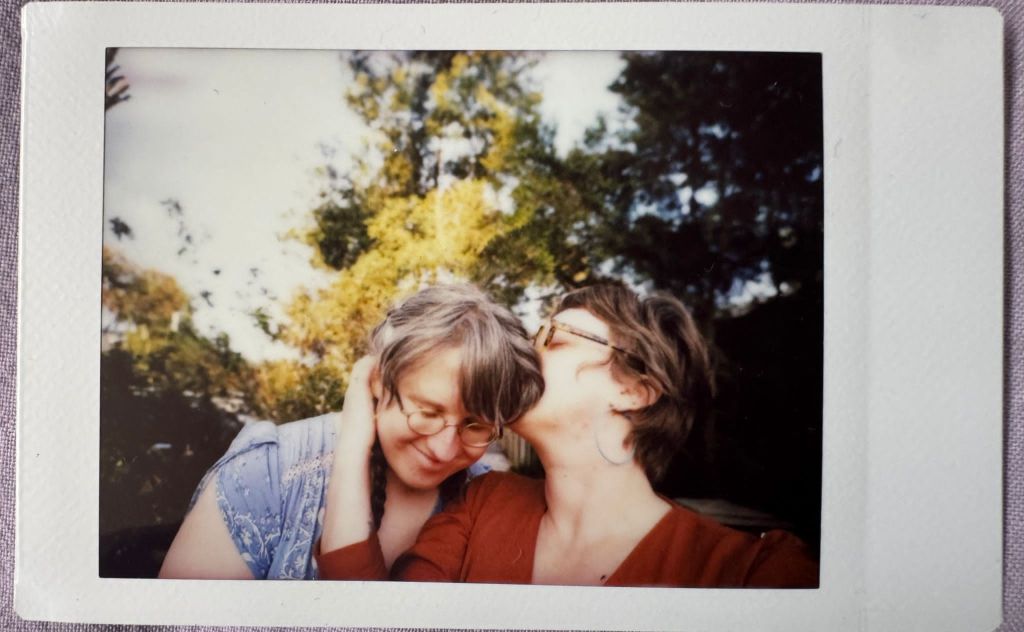
I’d originally planned to write more regular updates throughout my transition, but I’ve been valuing privacy a bit more than I used to. Especially once I started my relationship with my girlfriend (a bit over six months in), I was working through a lot of things with her that felt like they could only exist within that soft private space, and I had no desire to open that space up to public commentary. She’s been such a massive part of what’s enabled this transformation in the way I relate to myself, at a certain point it became hard to disentangle: what are the effects of HRT, and what are the effects of her? Being loved in such a distinctly lesbian way – her unhesitatingly experiencing my body as feminine before I was able to – has had profound limbic effects on me that I don’t know how to even start quantifying. Even though I’m an atheist, these are sacred things, and I hesitated to try to box them into words.
Also, I suspect, my need for what writing gives me has lessened. Writing used to be the primary way that I attempted to make myself understood. When I’d write a big introspective blog post and people told me they liked it and related to it, that was genuinely (don’t laugh) some of the best-feeling human connection I could scrabble together. I’d done all this work to arrange my insides into words, and other people saw it and, I felt, saw me. But now that I’ve transitioned – and especially now that I’m (finally) in a fully lesbian relationship – I get to feel so much more understood than I ever used to. Not by everybody, obviously, but by the important people, where it matters most. Which leaves my writing, still as something I value and like and want to do, but with a much less desperate task to accomplish.
With that in mind, I think I’ll try to write more often and less self-importantly. I don’t need to have some big Thesis About Transness to share; I can just get out some thoughts. With that in mind, here’s a silly little thought about dancing.
*
I’ve never been a party person. I’m bookish and socially anxious and have auditory processing difficulties with loud background noise, and so, while I have dutifully hauled myself to many parties throughout my life, I’ve usually slunk away within an hour or two. My goal is generally to find somebody I can have a good one-on-one conversation with in a quiet corner, and then leave before anybody gets drunk. In other words: my goal is for it to be as little like a party as possible. There are countless scenes in movies and books that earnestly try to convey a particular inchoate magic in people partying and dancing – these thumping magic circles of people losing themselves to music and drugs and possibility – but I’ve always scuttled away from anything even close to that. Rather than coming right out and saying ‘this is my nightmare, I have to leave immediately’, it’s always seemed reasonable to at least say: ‘hey, it’s not my thing.’
(I actually wasn’t a bad dancer, funnily enough. I always had the air of a nerdy twerp who’d be hopeless at it, so I frequently got credited as ‘surprisingly good’ – but it was always fairly calculated on my part. I studied the movements of better dancers and did what they did. I never actually lost myself in the music, and what the true acolytes of partying got out of it was always mysterious to me.)
But hang on – can I imagine partying as a lesbian? Dancing with women in a woman’s body? Making eye-contact with a stranger and feeling a gay frisson cut through the music-thick air? Suddenly all those dull party scenes in movies are shot through with a kind of electricity. Suddenly I get the appeal. Sweat and flash and women’s fingers in the loops of each other’s jeans. There would be a reason to be there, and very good reasons not to leave.
Before transitioning, I always felt like I was spoiling the vibe just by being there, and I imagined others being secretly grateful when I left. Now, I don’t think this was actually true (at least not widely) – it would be narcissistic to think people were thinking about me that much at all – but it was unavoidably part of the psychic equation on my end. Being at a party meant being perceived as a man at the party, which was a prospect I found too mortifying to ever enjoy. But being a lesbian at a queer party? Holy shit. That’s a wildly different value proposition. And realising this has made me re-evaluate how much of this trait that’s always seemed so obvious and inherent to me (that ‘I don’t like partying’) has actually been entwined with dysphoria this whole time.
The irony, of course, is that I turned 36 this year, and my prime partying days would be well behind me even if I’d made any use of them. I certainly don’t think my aversion to partying has all been dysphoria – I’ve always been a ‘let’s get cosy with tea and a book’ kind of person, then and now – but there’s something to be said for how transitioning has simply made the whole notion comprehensible to me in a way that it never was before. The idea of dancing with strangers, of being a body among bodies, of flirty but dialogueless conversations happening between pulsing physical entities running free … it’s just a lot easier to understand the appeal of that kind of thing when you don’t feel like your body automatically locks you out of every kind of encounter you could actually want to have. The whole thing makes more sense when the idea of being ‘a body among bodies’ doesn’t flood you with primal, deathly, inexplicable dread.
Not listed among the common effects of HRT on the print-out the endocrinologist gave me:
“You may suddenly, after years of not getting it whatsoever, understand why people dance.”
 ada connor