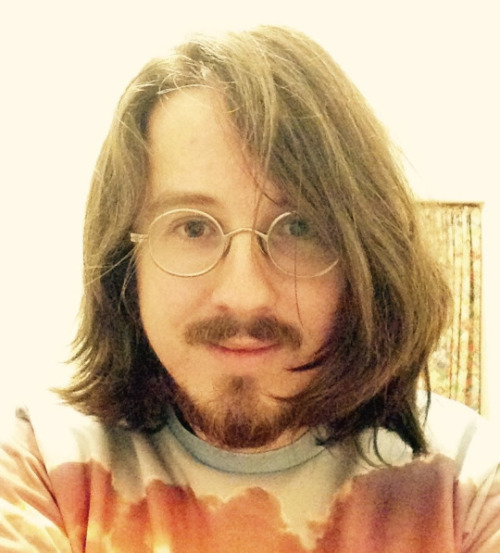
So I’ve been thinking about this a lot (a lot a lot a lot). I’ve been reading, and exploring, and paying closer attention to myself than I ever have before. I’m not a man, and I’m not a woman either. I’m something in between, something elsewhere. In the deepest parts of myself, I’m a gentle kind of neutral.
I’m still figuring stuff out. I may not settle completely on any one label. The way I see it, labels are tools – good to the extent they’re useful – and I’m still exploring what these different words might make possible. ‘Nonbinary’ does some important things for me, as does ‘neutral-gender’, but at the moment I think ‘agender’ might do the most. There’s often a bit of conceptual slippage in the usage of the word ‘agender’ between having no gender identity at all, and having a gender identity that is actively neutral. I actually really like that slippage. I think I live in that space where it slips.
I’ve identified as a boy/guy/man my whole life up until today, but it was only ever because it felt like the path of least resistance. It felt like going with the flow, like not making a fuss. I never identified with masculinity – never came close to seeing myself in it – but people treated me as a boy, so I figured I was one. I figured that’s how it was for everyone.
What I’ve been coming to terms with more recently are the twin thoughts that (a) my identification as a guy has been a more active choice than I realised, and (b) something else can fit better. I have a real tendency to think that if I can function, I’m fine – that I’m never sick enough to need medicine, and that it’s almost never worth me bothering anyone for help or support. But things don’t have to be the worst before you’re allowed to try and make them better. Something important slotted into place in my mind when I read Asher Bauer’s Not Your Mom’s Trans 101 (which I thoroughly recommend), particularly the passage:
The language of self-identification is often used to describe trans people. “George identifies as a man.” “I respect Judy’s identification as a woman.” “Chris just told me that ze identifies as ‘genderqueer.’ Oh dear, that pronoun is going to take some getting used to.” […] Cis people seem to think that self-identification is only for trans folks. They don’t have to “identify” as men and women– they just ARE! Their gender isn’t “self-identified,” it’s “self-evident!”
What they fail to understand is that self identification is the only meaningful way to determine gender. Any other method is wholly dependent upon what that doctor said way back when we were still wrinkly, writhing, screaming newborn messes, completely unformed as individuals and without any identity at all to speak of, too bloody and scrunchy-faced to even be called cute. The fact is that cis people self-identify too– they just happen to agree with what the doctor said all those years ago. Anybody who answers the question of “are you a man?” or “are you a woman?” with “yes” has just self-identified.
Before reading that, I never really considered that I was making an active choice by identifying a man. I thought everyone else was making that choice for me, and I was just being polite(?) by going along with it. I never thought that it could actually be my choice to make. I don’t think I have a pronoun preference – (and I’m 100% only speaking for myself when I say that; pronouns are massively important to lots of nonbinary people, including plenty of agender people) – but there are a lot of other things around this that I want to explore. I want to explore how I would identify ‘if I could choose’, because as it turns out … I can?
I’ve always known that I secretly like lots of ‘girly’ things. I used to sit in the living room while my mum watched Gilmore Girls, studiously pretending to read a book whose pages never turned. But this goes deeper than that. Guys can like ‘girly’ stuff and still be guys, just like girls can like ‘guy’ stuff and still be girls; that space is super important to protect. But the way I liked certain things, which parts of them called out to me … there are clues there.
Between the ages of 11 and 14 – while puberty was happening to me, and gender started to matter more in everyone’s lives – I disappeared almost completely into videogames and fantasy novels. They were an escape from a lot of things (bullying, isolation, Wangaratta in general), but in retrospect I can see that gender was a huge part of it as well. Elves didn’t seem to care very much about ‘man’ and ‘woman’: everyone was just pretty and wise and in touch with growing things. When I got my new glasses a little while ago, Jini said that they were very me – “pretty and wise” – and I got choked up.
Going back even earlier, there’s a song from the Marcy Playground album my brother Paul left behind called “A Cloak of Elvenkind.” When I was a kid, I loved it. I listened to it all the time. I had no conscious idea that it was about gender, but when I revisited it recently, I realised that its lyrics literally go: “A cloaking robe of elvenkind / hangs in my wardrobe behind / all the things that mother said / were proper for a boy.”
The connections aren’t exactly subtle.
Still, my brain went to great lengths to hide them from me. It’s a heavy thing, realising that you don’t actually fit in these categories that you’re taught fundamentally structure the life of every human being. “Humans are boys or girls”, I was taught; ergo, if I wasn’t a boy or a girl, I wasn’t a human – I didn’t exist. It wasn’t my brain’s fault; it was just trying to protect me from existential nullification. I didn’t have the vocabulary to understand a lot of experiences I had, so I came up with alternative rationalisations for everything that might have steered me in the right direction.
One small example: if you’d asked me between the ages of 12 and 17, I would’ve told you that I had a crush on Hermione Granger from the Harry Potter books. Even though everyone at school called me “Harry” from year 7 to year year 10 (because I had dark hair and glasses; great job guys), it was Hermione that I really liked. She was smart and principled and pedantic and obsessive and kind, and I totally adored her character. When I discovered internet fanfiction when I was 14/15, I immediately went looking for some hetero slash involving Hermione. (I assumed that’s what I wanted.)
Long story short: I hated it. I wasn’t sure why, but it made me really uncomfortable. There were some gentle Hermione/Ginny stories I enjoyed, but all the explicit hetero stuff with Hermione just made me feel awful. What I realise now is that I never actually had a crush on Hermione. I identified with Hermione. She was the most like me of anyone in those books. I saw myself in her, and gravitated towards her. My patriarchy-raised brain couldn’t quite comprehend having such a strong emotional attachment with a female character without it being romantic/sexual, so I filtered the experience through the conceptual schema available to me at the time. “I have a crush on her” was pretty much the only ‘acceptable’ way I had at the time to understand those feelings.
Needless to say, it’s nice to begin understanding my attachments properly. It’s nice to stop forcing my thoughts into a mold that they never actually fit. It’s nice to feel like a fuller and more honest version of myself. I bought this cheap necklace the other week – a replica of Hermione’s Time-Turner – and I’ve been wearing it under my clothes most days since. It feels good to have her with me.
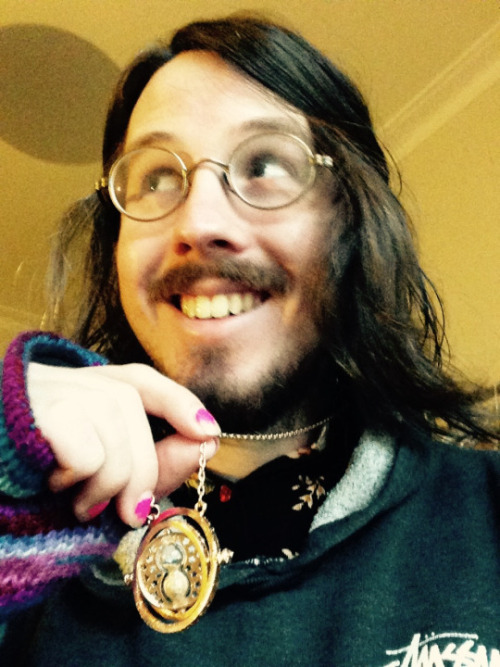
It’s been really interesting exploring clothing recently too. I was a massively cerebral kid, very disassociated from my body, and it was alarmingly easy for me to slip into this snobby mindset of “appearances are superficial; I’m too smart to care how I look.” I thought of clothes as irrelevant – as rags hanging off a brain. I tried to make as few active decisions about clothes as possible, mostly wearing hand-me-downs, gifts, and cheap blank grey T-shirts. (Of course, in reality those were active decisions, calculated to try to communicate “look how intellectual I am, not caring about my appearance at all” – but just as I didn’t understand that I was making a choice by identifying as a guy, I didn’t understand that I was making choices about my clothes too.) Caring about clothes and appearance was something other people did, I told myself, and I had this whole elaborate story about how I was better than them because of it.
Over the last few years, those walls have been coming down. I think reading this piece by Greta Christina started the process. (”Fashion is one of the very few forms of expression in which women have more freedom than men. And I don’t think it’s an accident that it’s typically seen as shallow, trivial, and vain.”) I began to read feminist philosophy, and to recognise that my lifelong devaluation of appearances, of the physical and sensory, didn’t pop into my mind from nothing; it came from somewhere. Specifically, it came from a long history in Western thought that has everything to do with the devaluation of women.
Slowly, I began to look at my wardrobe and think, “Wait, why do I have so many grey T-shirts? I love colour.” I used to look out for band T-shirts that were particularly colourful – a good teal or green or peach – and be really happy when I found one. It’s funny: I couldn’t go out and just get a shirt I liked the colour of, but if it was a band shirt, I would have an ‘excuse’ for wearing it. It’s the same reason I bought a variety of colourful NBA jerseys a few years ago. Ridiculous, right? No-one was actively policing me about that, but I was still left looking for loopholes in my own weird self-policing.
I don’t want to do that any more. I want to be freer about wearing what I actually like. In the past, I honestly never really thought I could actually be happy with how I look. I thought I could never ‘win that game’ (i.e. be attractive), and so the best move was to just aggressively not play. I never countenanced the notion that my outside could actually serve to more accurately embody who I am inside. I never realised that’s what anyone was doing and expressing with their clothing. That whole world just seemed totally unavailable to me. But in the last few months, I’ve started playing around with clothes and hairstyles and presentation, paying unfiltered attention (for pretty much the first time) to what I actually like. In the last few months, I’ve started freely acknowledging how much I love swishy skirts …
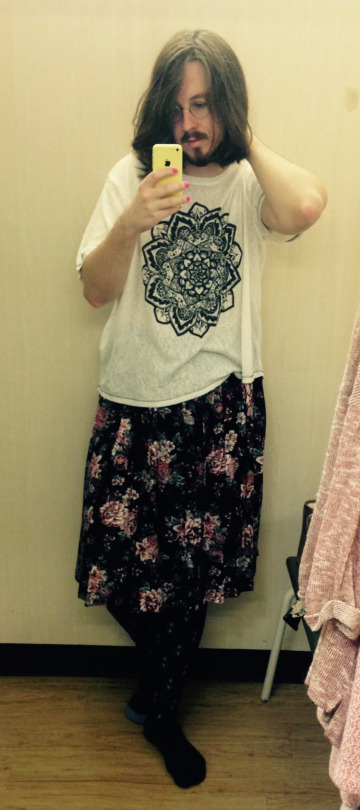
… and cute gloves and nail polish …
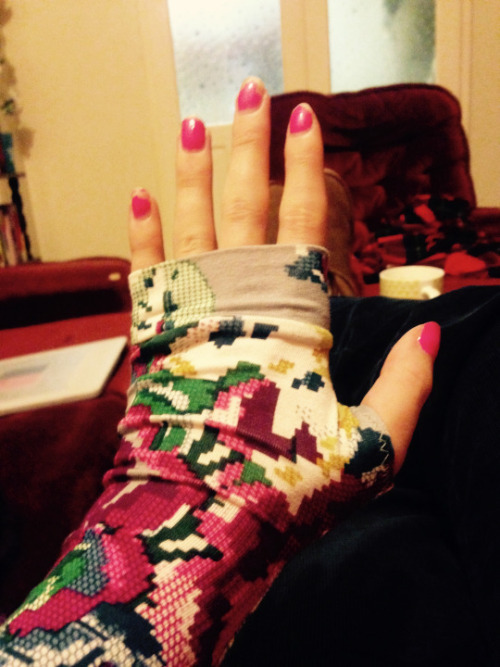
… and soft hair …
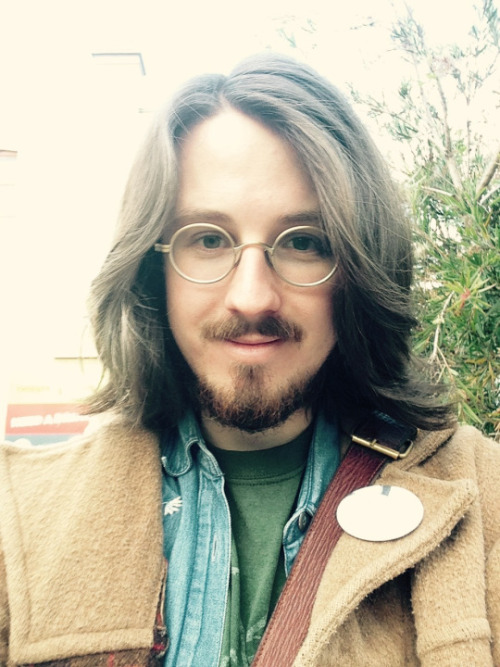
… and dorky corduroy overall-dresses.
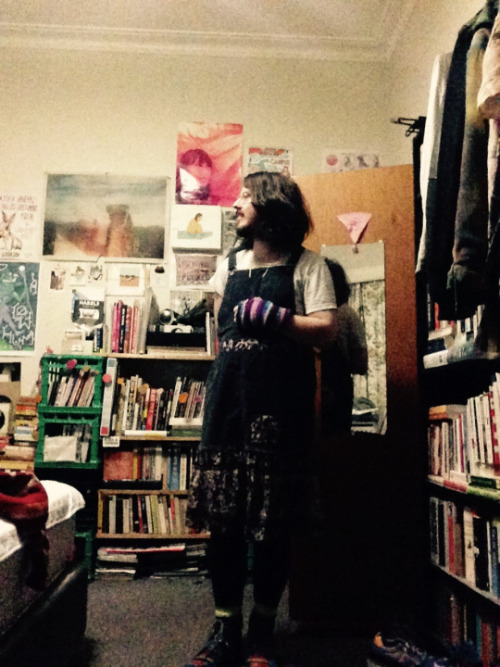
It’s felt really nice.
The first time I saw that corduroy dress (on Etsy), I had a really strong emotional reaction I can’t quite quantify. I had this sudden vivid image of a particular imaginary person who would totally wear that dress: this kindly laughing lesbian neighbour with gumboots and long flowing hair, lots of musical instruments, and a house that always seems warm inside. Out of nowhere, staring at the dress, I started to cry.
I don’t want to ignore these things any more. I performed with the Parking Lot Experiments the other night in that corduroy dress, and it felt so good. The childlike energy of that dress, combined with the frantic, muscular way I drum … it felt like rubbing sticks together and creating sparks of androgynous joy. It felt like being free to love every single part of me.
*
There is a very forceful part of me that wants to say that none of this is worth talking about. There’s a part of me says that because I didn’t experience the kind of acutely distressing dysphoria a lot of nonbinary and trans people do (more just a … niggling sense of dissatisfaction and gendered loneliness), the more circumspect thing to do would be to keep quiet about this and continue life as a cis guy. Another part of me can’t help but think of the women who’ve told me privately that I’m the only cis straight dude they trust, which makes me worry that suddenly saying that I’m agender would essentially be telling them “oh, my bad, there are actually no cis straight men you trust.” Which is really depressing.
Everyone I’ve shared those concerns with has been unanimous in thinking they’re ridiculous, and absolutely not worth hiding this over. I know that they’re right, kinda. But it’s hard. I’ve been raised and socialised as a guy, so there’s still an awful lot I have to unlearn and recalibrate in order to exist in the world non-oppressively. In no way do I think being agender exempts me from being present for feminist critiques of men. I was raised to be one, and that still did a number on me, just like it did on all of us in this society. It’s important that I’m still there for that.
*
This is far from the most dramatic and consequential kind of coming-out. Nobody needs to use any different pronouns, I’m not looking to alter my body in any way, and aside from noticing me having a freer reign over my wardrobe, this isn’t likely to have much effect on anyone except me. But it will have an effect of me, I think: a freeing, calming, enlivening one. Because what I really want to say is this:
I’m a deeply neutral person. That’s who I am. I don’t mean politically neutral (I believe in lots of things), and I don’t mean epistemically neutral either (I have biases, and come from somewhere very specific). I mean ‘neutral’ in the sense of being careful and responsive and adaptive to my core. I mean ‘neutral’ in the sense of a river filling the space available to it.
An example from a different area of life: right now I’m with someone who needs to be in a poly relationship to be happy, so I’m doing poly and am very happy in it. If I were to find myself in the future in mutual love with someone who needs monogamy to be happy, I would 100% do that and be very happy in it. Some polyamory writers I’ve read insist that everyone has an orientation that ultimately leads more one way than the other (and that poly-orented people should only date other poly-oriented people), but for me, the thing is more fluid and adaptive than that. On my own, I’m not really anything except responsive. I only gain a temporary orientation with regard to that stuff in collaborative response to particular individuals. My poly/mono orientation in general is: “What is the best way to love the person in front of me?”
In a similar sort of way, I’ve never understood what it could possibly mean to “feel like a boy”, or “feel like a man”, or “feel like a girl”, or “feel like a woman”. (For a long time, this actually made it really hard to relate to trans people’s experiences, as I had no experience of internal gender identification to relate it to. I believed them when they spoke, but it was just hard to comprehend with the language that’s commonly used. They’d say, “Well, you know how you just know you’re a guy, right?” and I’d be like, “Buh?” I was only a guy out of habit, fear, and the desire not to make a fuss. I figured that’s what all cis people’s genders were.) But if gender were something better – if gender were something you could look inside yourself for and decide what self-understanding makes you happiest – then I’d get to acknowledge something more important.
When I look into the deepest parts of myself, outside of how I’m treated and read and understood by others, I don’t feel any gender at all. I just feel a still, calm, responsive space.
An open enclosure; a gentle valley.
A response waiting to make itself.
And a particular kind of yearning to make it.
*
Another thing I can understand a lot better in the light of this realisation is how much, ever since I was young, I’ve loved and identified with gay women. I don’t mean ‘gay women’ in the sense of some big homogenised group; I mean specific gay women, who made me feel things that no-one else in my life did. God, I’ve had so many crushes on queer girls. I used to have a whole stand-up bit making fun of myself for it. Over and over, I kept having these strong feelings for musicians and actresses and characters who I would only discover later weren’t straight. I kept feeling weird about penis-in-vagina sex, and secretly preferring all the other kinds. I kept surreptitiously reading Autostraddle.com (”they have great taste in books!”, I’d say to the imaginary inquisition in my head). I kept having these experiences of feeling deeply at home amongst gay women, but only being able to talk about them in really cryptic ways (look at this post from 2010, at the way I grammatically absorbed myself into “the crowd”). I kept crying reading Adrienne Rich. This is … whatever it is, it’s a thing.
And it makes sense, right? If I’m not actually a man but I amattracted to women, of course I’m going to feel more drawn to queer women than straight women. Of course I’m going to feel more of an affinity for queer and lesbian relationships than heterosexual man-woman ones. They’re closer to something I could actually feel fully seen and affirmed in. They’re closer to the kind of people who could find me attractive, not for the man I’m supposed to be, but for who I actually am.
They’re closer to who and where and how I actually want to be.
*
Fantasies and idle daydreams can sometimes tell you a lot. When I was 17 and in my last year of high school, I became obsessed with the San Francisco band Little Teeth. I listened to their album “Child Bearing Man” once a day for at least six months. I’ve tried lots of times, but I’ve never really been able to articulate what that album did for me emotionally. It shook me up and touched all these parts of me that I didn’t even know were there. Around the same time, I started idly daydreaming about this alternative reality where Dannie Murrie (from Little Teeth) transferred to my high school.
I loved those dreams. She was this hilarious surreal don’t-give-a-fuck art-rebel, and even though I was still just a nerdy overachieving dork, we became really tight friends, and spent all our time lounging in the furthest corner of the common room, talking and making paper airplanes and forgetting anyone else was even there. I daydreamt entire elaborate “plotlines”: where we’d enter the school’s Battle of the Bands with a chaotic performance of some of her songs; where I’d leverage my “good kid” status to sneak her out of detention; where other kids from my year level would try and figure out our relationship (”like, are they boyfriend and girlfriend? are they having sex?”), and not even get close. In retrospect, I think what I was fantasising about was a kind of intimacy freed from gender constraints – about being seen and understood by a person the way I felt seen and understood by Little Teeth’s music.
I sent Dannie a fan letter one time – an unbridled, super-weird expression of massive admiration and connection. We became friends on facebook, which was great: I loved getting invited to Little Teeth shows in San Francisco, even if I could never actually go to them. It was a tiny feeling of connection to my daydreams, but we didn’t correspond more than that. Then one time, two years ago, Dannie sent me a message saying she wished I could come to a particular potluck at the Pink House, and I expressed my regret at still being thousands of kilometres away. She replied:
oh !
i knew you lived down under (forgive me)
it was just a wishful invite i think
also,
for some reason- i think of you often
i ’m not exactly sure why
i think that when things get really dense/oblique and it seems like i’m lost in a directionless abyss of production and interpersonal-b and dysmorphia
i remember how genuine you were in expressing your anticipation for the album and it keeps me going
really! sincerely
thank you
you are very special i just know it
you are in my heart for some strangely psychic and real reason
God, re-reading that is making me cry again.
There have been moments in my life when I’ve felt like I have been seen that way – understood the way Dannie and her music somehow understood me – and they’ve felt so incredible. There was one moment with a previous partner in particular, early in our relationship, when we listened to The Milk-Eyed Mender together in my bedroom, and I cried great heaving sobs. I think that was the moment that they realised for the first time who I am, and – amazingly to me – didn’t reject it. It was then that I realised who I was allowed to be with them. It was then that I realised who, the whole time, I had wanted to be with them. (I wrote this post the next day, still buzzing from the feeling.)
If the core of me is this adaptive, bendy, pragmatic neutrality, the main thing I have available to listen to is the quiet voice (the breeze in the valley) telling me who I want to adapt to. And that breeze has only ever blown in one direction.
Even tiny things, like when a queer friend recently reblogged something I wrote and jokingly added “Andy I’m so gay for you right now” – I turned that little sentence over and over in my head for days, delighted. The faintest suggestion that I can be related to as something other than a straight cis man (even a suggestion made in hyperbole) makes me feel wonderful. Things like that are like arrows, Tommi said to me recently, pointing you to where you want to go. Being found attractive as a straight guy has never sat well with me. Honestly, I never quite believe it. Being found attractive by a woman in a gay or queer way feels so much more real to me – as strange that probably sounds if you encounter me as a guy – because it feels like it’s definitely me that’s being found attractive.
That’s the shape I want to responsively assume. That’s the riverbed I want to fill. That’s the person I want to be, which (as the Sorting Hat knew) is a very large part of the person you actually are.
I don’t really know what to do with any of this. Janet Hardy introducing me to the word ‘guydyke’ was invaluable as a prompt to begin exploring this stuff, but the word doesn’t actually feel very good to me (because I don’t think I’m really a ‘guy’, and because ‘dyke’ feels too sharp on my tongue). Ultimately, I don’t think I need to grasp after a label with this aspect of it. I’ll just keep building the beautiful mutualistic relationships I want, and some people will privately see and value the parts of me that sing out to Adrienne Rich and Joanna Newsom, and most people won’t, and that’s okay.
*
The last thing I’ll say is this:
Imagine an ideal world. Like, a really ambitiously ideal world, where where racism doesn’t exist and rape is unthinkable and there’s no domination of the poor by the rich and everything is pretty much as good as it could be. In this hypothetical ideal world, no-one – absolutely no-one – would be forced into gender roles. It’s not that there’d be no gender at all, I don’t think; it’d just be that gender would be something self-negotiated, chosen by people themselves. All of society’s pronouns and honorifics would be gender-neutral by default, but everyone would accept and respect gender specification as an optional component of a person’s emotional and mental self-understanding. Nobody would be ever demeaned, oppressed or harmed on the basis of their gender. Toys and clothes wouldn’t be gender-segregated. Tampons wouldn’t be marketed to “women”, but, more sensibly, to “people who menstruate”. Everyone would be free to be who they want to be.
Thinking about that hypothetical ideal world, honestly, makes my choice in this one so much clearer. If I grew up in that ideal world, there’s no way I would identify as a man. None. There’s nothing for me there.
What I would be in that world is a happy, neutral person. I’d wear lots of loose, flowing, sunset-coloured clothes, and move gently through the world. I’d paint my house in pastel colours, because if there’s one thing I know it’s that I truly do love that. I’d have relationships built on trust and mutuality, on seeing and being seen. I’d write books, and build intricately detailed worlds in which people lost themselves and found themselves. I would honour the open enclosure inside of me, and live in the valley.
And so then the thought finds me:
If I would do that there, why can’t I do it here?
Who’s stopping me, and how much do they really matter?
Why can’t my worldbuilding start where I live?
 ada connor