I’d been warned about this particular video game. “It’s really good,” a friend told me, “but there’s some potentially triggering stuff about suicide in there.” I go into these kinds of things with my eyes open.
The game is called Life is Strange. In it, you play an eighteen-year-old girl named Max from a small fishing town in Oregon. One day, in photography class, you discover that you can reverse time. When the game lets you, you have the option of holding down a button to move your consciousness back in the flow of time, re-experience a situation, and do things differently. The first tests are small: you hear an answer to a teacher’s question in class, then go back and give it as though you’d always known it. Then things escalate. You save your friend Chloe from being shot dead in the girl’s bathroom, and an elaborate mystery storyline unfurls from there. It’s accompanied by eerie weather events that coincide with the advent of your powers. None of that has much to do with Kate Marsh.
A short, timid, Christian classmate of yours, Kate was drugged and assaulted by a group of rich assholes at a party. She is virtually disowned by her hyper-conservative mother because of it. The game gives you a number of small opportunities to help Kate, like rubbing something mean off the slate outside her door, or stepping in when she’s getting bullied by the school’s head of security. You try to support her, but you always get the sense that you could be doing more. Then, all of a sudden, towards the end of the game’s second chapter, Kate is standing on the edge of the roof of the school.
Everything slows down at this point. Grey rain hisses all around you. Kate blurs from place to place like the misaligned frames of an old photograph. You manage to pause time long enough to stagger up to the roof, but by the time you’re up there, your powers are totally conked out. You can’t control time anymore. A crowd has gathered down below, phone cameras pointed up, but you’re on your own. Something inside your chest feels like it’s trying to punch its way out.
“What are you doing here, Max?” “Kate turns around to glare at you, her face flush with tears.” The small crucifix around her neck seems neon against her soaked cotton blouse. This is the first time you’ve seen her angry. “Max, seriously, don’t come near me! I will jump!”
Kate’s voice is loud and strained, but her mouth doesn’t quite match the sounds she’s making. Tears mingle with the rain on her face, but her hair is dry. You try not to think about how wrong her mouth looks. Something you did once mattered, and she mentions it. Another thing you did was disappointing; she mentions that, too. One by one, your past actions are totted up in a list. How did you support her? How did you make her feel? Suddenly, two options appear in the sky:
[left click] Things will get better. [right click] You matter, not just to me.
The first option feels phony, so you choose the right click. Every choice afterward is like this. Kate continues to cry, insisting on her hopelessness, and you have to choose the least-worst of the binary choices that hover in the sky. You can’t take too long to choose, though. That’s its own choice.
The clicks of the mouse start to seem heavy and far away. The game presents you with a choice between two Bible verses, and you can feel yourself dissociating. You have to say the right words or she’ll kill herself. There’s a throbbing in your head. You pause the game, and find yourself staring at biblegateway.com, trying to figure out what these verses will mean in this context. It’s hard to remember how sentences hang together. Matthew 11:28 goes like this:
Come to me, all you who are weary and burdened, and I will give you rest.
This seems like a dangerous thing to say to an extremely religious person on the brink of suicide. You don’t want her to come to Jesus for rest; you want her to step down from the ledge. Away from Jesus, if you please. The other verse, Proverbs 21:15, is angrier:
When justice is done, it brings joy to the righteous but terror to evildoers.
Kate’s not the fire-and-brimstone type, but she did seem heartened when you told her that you were looking for evidence to nail Nathan Prescott, the preppy sociopath who drugged her. Her soft heart is clearly stung by the injustice of what happened, so maybe a little Old Testament retribution could help the situation.
You choose the Proverbs verse. It’s the wrong one.
Kate steps off the roof of the building. She falls in slow motion, her body bending in the slipstream of the air. You bring your hands to your face, making a horrified mask over your mouth and nose. Kate is dead. You emit a strangled noise, and slump back in your chair. You’re staring at the computer screen. You glance across your room, towards the secret compartment where you keep the stash of sleeping pills Kat gave you the last time you saw her. You don’t leave the house for a week.
My friend who killed herself was named Kat.
*
Imagine an abscess in your brain. Every day, your neurons direct electricity through habitualized routes, doing jobs they’re used to doing. The more regularly those electrical impulses travel to particular places, the quicker and more efficient their journey becomes. The tubes get oiled, the lanes get expanded, and they get settled into their route. But when someone you love dies—when a central component of your mental map is suddenly gone—your neurons don’t stop directing electricity down those well-worn paths. After all, the infrastructure is already built. They go down that way every day. How would they know to stop?
And so your neurons steer you off a cliff. Every day. This is what losing a loved one means: the daily careening of mental electricity into the gaping chasm of their absence. The daily plunge and crash of a whole highway’s worth of cognitive impulses, plummeting into the smoldering wreckage of yesterday’s.
The abscess never goes away. Gradually, over months and years, your neurons learn to direct traffic around it. The topography of your brain is always marred, but you just learn to live with it. You work around the abscess. This is the best way I can describe grief.
*
Most video games are power fantasies, but the most significant power-fantasy afforded by video games isn’t the ability to kill monsters with fireballs from your hands. It’s not saving a princess, or saving the world, or saving the universe. It’s just saving. The most important power fantasy afforded by most video games is the ability to save and load your game.
It’s a colossal power, when you think about it. Saving and loading gives you the power to make a mistake, and then go back in time and do it better. It empowers you to be imperfect, but also, where it matters, perfect. It lets you live every possible iteration of yourself, while still being yourself, both inside and comfortably outside of the pull of time. It allows you to experience death while remaining immortal.
When I was a kid, having savegames in real life was my most persistent fantasy. Even now, when I’m anxious or depressed, I’ll often find myself trying to mentally ‘load a savegame’. It’s a tic that doesn’t involve any outward expression, but I just try to click on where I think the menu might be hidden in my mind. The hope is that one of these times, the menu will simply unfurl, and I’ll realize it’s been autosaving for me this whole time, and I’ll finally be able to load up July of 2015 and get to work.
In Life is Strange, the fantasy of saving is turned into the game’s core mechanic. While the thematic point of the game ends up being that this kind of perfection is unattainable—that some losses are unavoidable—the experience of playing it tells you the opposite. Every time you fuck something up, you can hop back in time and reverse it. Every time you’re curious how someone would react to a different rhetorical strategy, you can zip back and test it out. The whole thing is about re-experiencing situations, folding a single life over itself again and again in the pursuit of better outcomes.
Until the roof. Then you’re on your own, stripped of your powers through a convenient plot contrivance. Then you’re watching your friend teeter closer to killing herself, with only one chance to avoid saying the wrong thing. In that situation, you’re a pianist whose hands have fallen off. Every sinking platitude you say is like the klumpf of your handless arms smashing against the keys. To be fair, this is realistic. This is what it feels like to try to convince someone not to kill themselves. An atonal jumble of helpless notes that never quite makes the chord.
These are the last text messages Kat and I sent to each other:
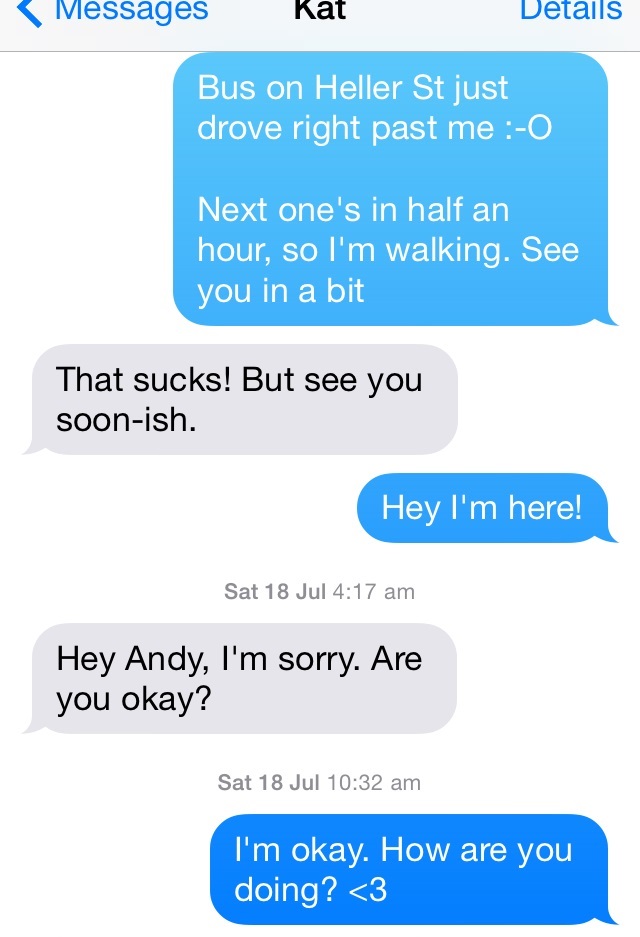
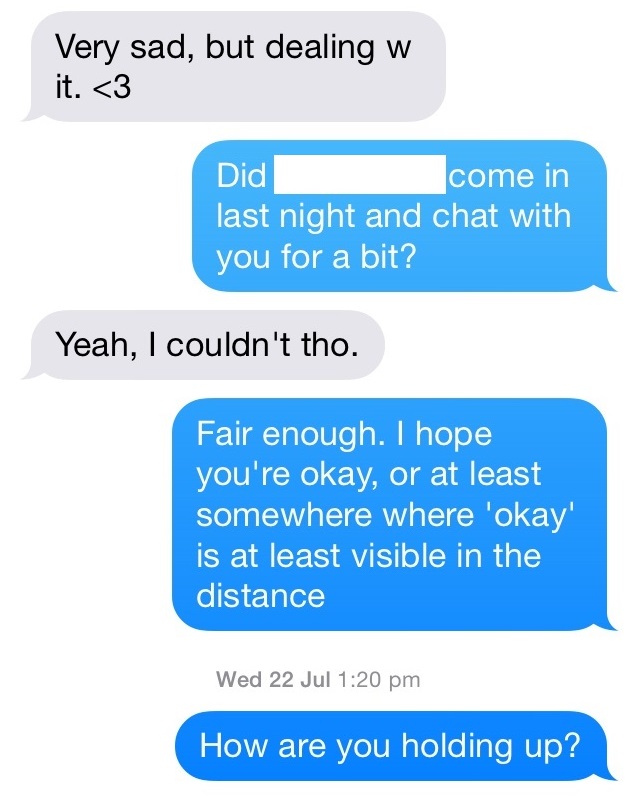
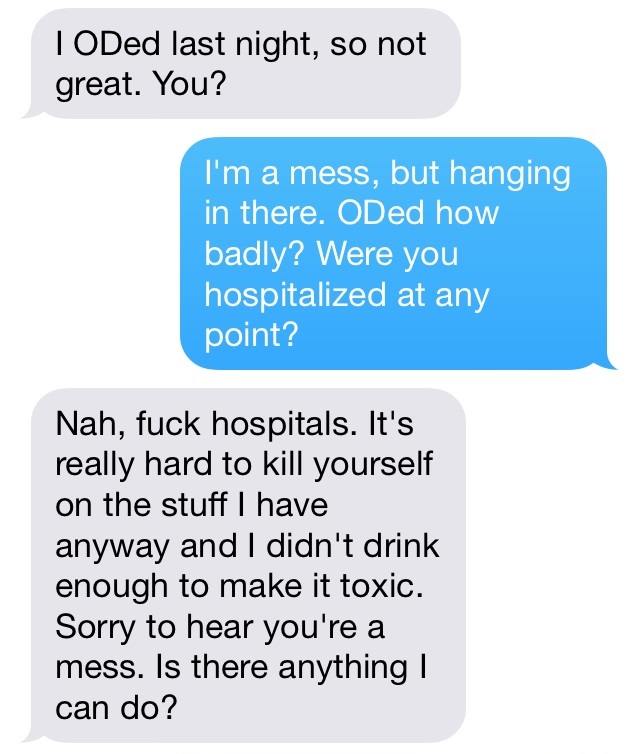
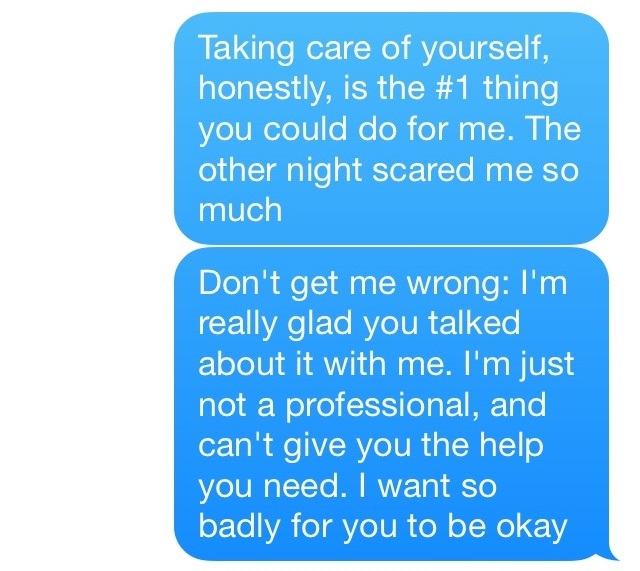
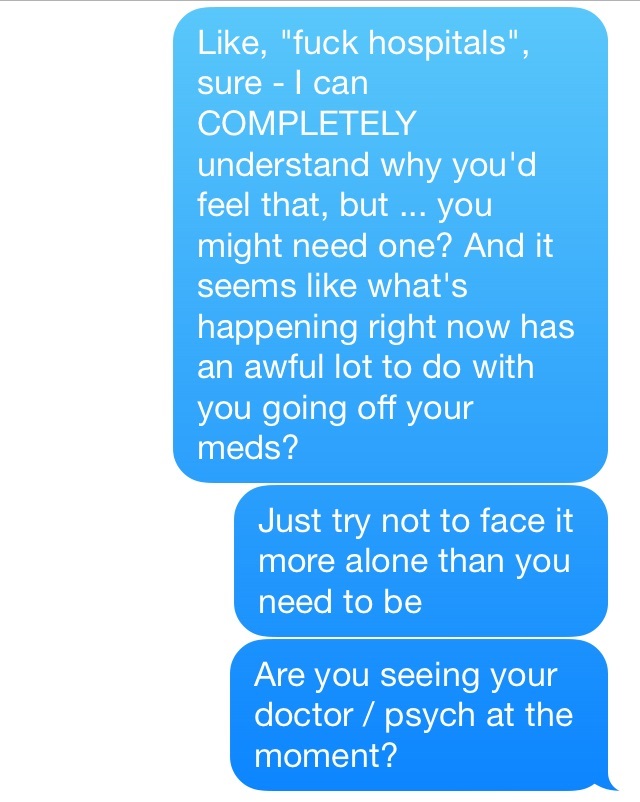
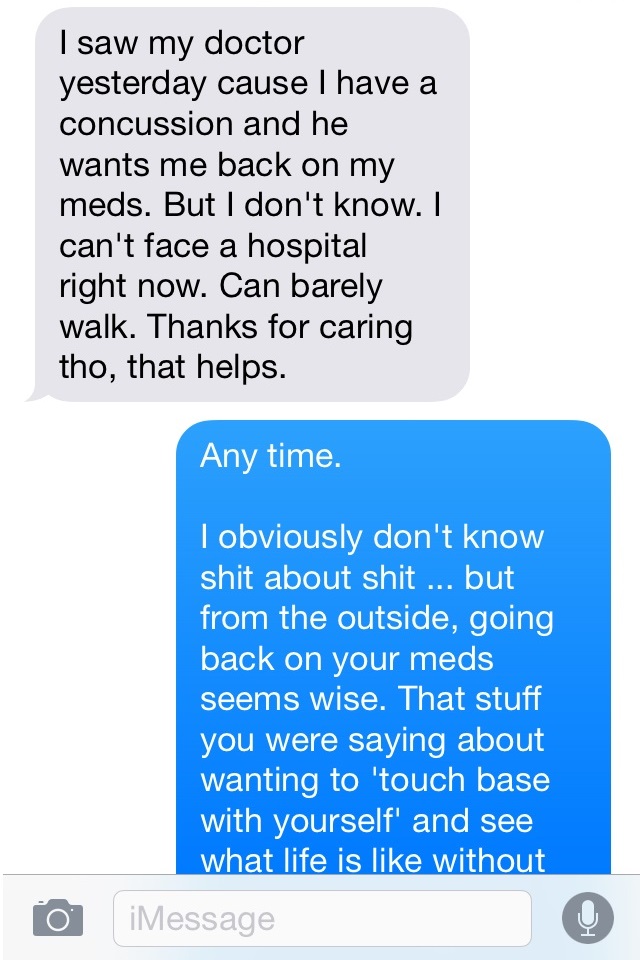
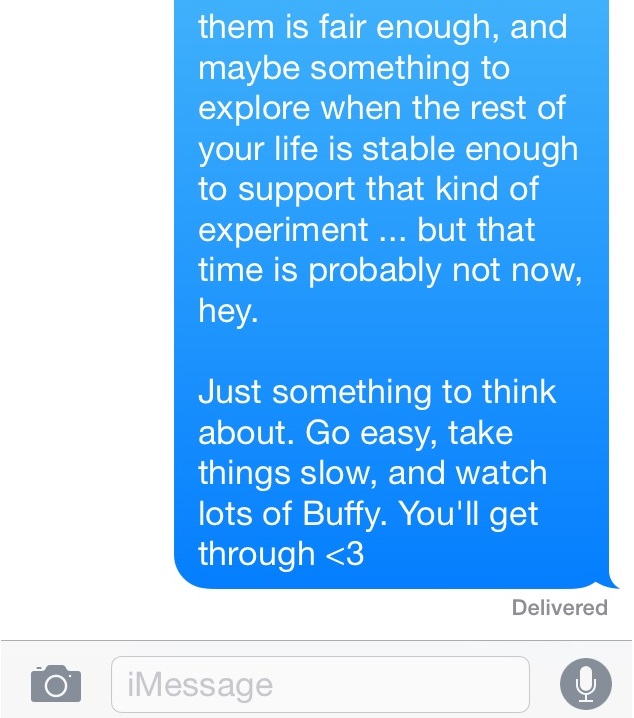
I’ve read over these messages so many times. These were the options I picked out of the sky. Every following day that I didn’t text was another option in the sky. Everything I didn’t say to her was another button I didn’t click. Every hour I continue to live is a reminder of how far away from her I’m getting, and how I don’t get to go back and do better. This will always be what I did.
People have done their best to convince me that there was nothing else I could have done. Life is Strange, though, destroys that reassurance. It makes the player the causally determinative factor in someone else’s suicide. It’s an irresponsible narrative gambit on the developers’ part, but if I’m being honest, I was hungry for it. It confirmed every piece of molten self-incrimination that burned at the back of my skull.
For a long time after Kat died, I only referred to her as my friend. We were lovers, as well, but I didn’t know how to say that without feeling like I was misrepresenting something, because we were friends. We were supportive friends to one another both when we were sleeping together and also when we weren’t. Lots of people had that kind of relationship with her, because she was so good at precisely that kind of relationship. She always made it obvious what her love was based on.
*
When you read information from a hard drive, the drive stays intact. When you write information, though, the tiny transistors in the drive’s cells degrade. Every time you write, it exacts a tiny incremental toll on the hardware.
I don’t know how to tell these stories without rewriting the information in them. I don’t know how to prevent my memory circuits from degrading from the process. Every detail I mention makes it more likely that I’ll forget the ones I don’t.
Kat was a Star Wars dork. She was queer, polyamorous, and feminist. She wore black-rimmed glasses and tulle skirts and heavy Doc Martens. She was a writer who put an incredible amount of effort into making other people feel like they could call themselves writers. She said, “Right??” like you were the first person in the whole world to get it, like the search was finally over. She’d shiver with delight when you’d tongue her lip-ring—she called it the cheat code for making out with her—and hug you like you were trapped in a wind-tunnel together. She was basically always a little bit drunk.
Every time I write these details, my memory gets a tiny scratch on it.
*
Once you’ve used modding tools to fly a camera throughout their 3D environments, video games are harder to trust. The finished product may look stable and solid, but you know how fragile the illusion is. You know that the characters aren’t made up of blood and organs, but an internal nightscape of angles and glitches. You know that behind those painted-on doors is a fractal void of junked textures and geometric refuse. You know that what you’re standing on is thinner than paper.
That’s what it was like when I got the call. I sank against a pillar, and didn’t stop sinking. The world disintegrated into meaningless geometry.
I have no idea if anyone on the team that made Life is Strange has ever had a friend who committed suicide. When you say all the right things and Kate doesn’t kill herself, the chapter ends with a song and you texting your friend Chloe, “Let’s find out what’s going on!” The whole mystery is still going on, after all—the town, the eerie weather, the Prescotts, and your superpowers. But when you say the wrong things and Kate does kill herself, the same song plays. You look out over the same cinematic shots of the bay. On the day of Kate’s death, you end the chapter by texting that same friend, “Let’s find out what’s going on!”
Nobody sends a text with an exclamation point on the day that their friend kills themselves. They just don’t. It’s an error of realism so jarring, it’s more like an error of continuity, like they just lost track of Max’s personhood between shots. The game paints it as if watching your friend throw herself to her death—as a direct result of you failing to love her better—wouldn’t traumatize you, but would rather galvanize you to go out and solve mysteries. The game makes it seem like the world in which Kate lives, and the one in which she dies, aren’t separated by much. That, to me, is the worst part of it—just how little changes.
Kate is absent even if she lives. She’s in the hospital, and people talk about her in the same self-centered and regretful ways. If she dies, people are sad, but nobody actually grieves. Nobody is ruined. Nobody finds themselves staring at a ceiling for hours, wishing it would collapse on them. Nobody forgets to eat for two whole days until they crumple to the asphalt in a pharmacy parking lot.
I played two games of Life is Strange concurrently. The one in which Kate died, and another one in which I went all the way back to the beginning, did everything perfectly, and stopped her from stepping off of that roof. The differences were only marginal shading on the edges of Max’s life. A few odd sentences changed in the occasional conversation. There was no seismic difference, no sense of cataclysm.
This is less realistic than the time-travel, to be honest. Nothing in my life is unchanged by grief. I can’t forget how thin the world is.
Somewhere, there are two versions of my life playing out concurrently. One in which Kat dies, and one in which she lives. I know that if I actually had the power to save and load lives, I’d keep testing and tinkering. I’d end up spending all of my time in the spaces where she lived. Over time, her lives would proliferate. The more I saved and re-loaded and branched out, the ugly reality where she died would take up a narrower sliver of space, and the realities where she lives would bloom and branch apart. The “Kat is alive” timelines would be so voluminous, they’d crowd out the opposition. Ninety-nine percent of realities would be ones in which she lives. They’d ensnare buildings, overturn cars, and grow to every possible height. My friend would be alive so much more than she’d be dead.
Over time and underneath it, the fabric of spacetime would curl around us like a blanket. She’d take off her glasses to nuzzle into my shoulder, and I’d re-load that moment, again and again, a .GIF playing endlessly in space, until I’d finally lived there long enough to be okay with spending some time here too.
 ada connor