by Ada Connor
Master of Arts (Philosophy) Research Thesis, The University of Melbourne, 2017
.
This thesis is for Kat Muscat (1990 – 2015)
who loved love more than anyone I’ve ever met.
Preface
Love and abuse cannot coexist.
bell hooks,[1] All About Love
In any discussion of love and abuse, it should go without saying that the word ‘love’ is frequently abused. Those who abuse their intimate partners would like us to believe that the statement from bell hooks with which this chapter began – that “love and abuse cannot coexist” – is untrue. Abusive people are often heavily invested in the idea that they do love their partners, even as they treat them with entitlement and violence, and the society I grew up in frequently seemed to endorse this compatibility. “You always hurt the one you love”, crooned a song on my parents’ car radio. “The husband’s murder of his wife was a crime of passion,” intoned the newscaster, as his voice betrayed no sense at all of any contradiction in his words. In many of the films and television shows I grew up watching, romantic possessiveness was welcomed (because it showed he ‘really cared’), survivors of gendered violence were routinely blamed for their own mistreatment (“you must have done something to set him off”), and abusive tactics of control and manipulation were normalised to a disturbing degree. Not only was love made out to be a justification for abuse, but in some of the most dramatic and concept-defining cultural narratives of “love” I was exposed to, abuse was presented as love.
This is why, when I first read bell hooks’ All About Love: New Visions in early 2011, it shook me so much. I recall being struck not only by the unfamiliar clarity with which she spoke about love and abuse, but also by the sheer conceptual boldness of opposing the two as she did. For hooks, our society’s misidentification of love and abuse is pathological, and steeped in the injustices of a society built on domination. She puts her case bluntly:
[W]e cannot claim to love if we are hurtful and abusive. Love and abuse cannot coexist. Abuse and neglect are, by definition, the opposites of nurturance and care. Often we hear of a man who beats his children and wife and then goes to the corner bar and passionately proclaims how much he loves them. If you talk to the wife on a good day, she may also insist he loves her, despite his violence. An overwhelming majority of us come from dysfunctional families in which we were taught we were not okay, where we were shamed, verbally and/or physically abused, and emotionally neglected even as we were also taught to believe that we were loved. For most folks it is just too threatening to embrace a definition of love that would no longer enable us to see love as present in our families. (hooks, 2001, p.6)
Love is not often contrasted so starkly with abuse. Most of our common conceptions of love make the co‑existence of love and abuse entirely unremarkable. When love is primarily thought of as an overpowering feeling of attachment and emotional investment, for example, nothing about that is inherently incompatible with coercive or controlling behaviour. When love is thought to be a fated connection between two people – the metaphysically ambiguous ‘meant to be together’ spoken of in romance films – nothing about that construction implies that the fatedness might cease when one partner is profoundly cruel and undermining toward the other. When love is thought of as a series of sacrifices one makes for another, few safeguards exist to stop that commitment being taken advantage of by a partner who makes no such reciprocal commitment. Most of the ways we have to think about love, it turns out, do not provide the resources to say what hook says about it.
‘Love’ is already one of the most powerfully multivalent words we have. It can be either a noun (“I knew it was love”) or a verb (“do you love me?”). It can be either a relation encompassing multiple subjects (i.e “the love between Rose and Ruth”) or something intrinsic to a single subject (i.e. “Ruth’s love for Rose”). Yet more distinctions abound when it comes to determining just what that ‘something intrinsic to a subject’ is thought to be: a feeling, an attitude, a commitment, a destiny, a practice, or some combination of some particular shades of each. bell hooks, for her part, is extremely partisan on this subject: for her, love is best thought of as a practice, as something one chooses to do, and the various other meanings of love often just get in the way of the practice. She writes,
Most of us learn early on to think of love as a feeling. When we feel deeply drawn to someone, we cathect with them; that is, we invest feelings or emotion in them. That process of investment wherein a loved one becomes important to us is called “cathexis”. In his book [the psychiatrist M. Scott] Peck rightly emphasizes that most of us “confuse cathecting with loving.” (hooks, 2001, p.4-5)
The notion that cathexis might be something separate from love is a shot to the gut of many of our most popular conceptions of love. The stalker who has never spoken to his victim imagines that he loves her, and finds plenty of support for this notion in everything from Petrarchan sonnets to The Notebook. Even most philosophical examinations of love that I’ve encountered, while making varied kinds of contributions on the subject, fundamentally speak about love as something that happens inside a person. David Velleman speaks of love as an “arresting awareness of value” (Velleman, 1999, p.362). Irving Singer theorises love as the bestowal of a particular kind of value which cannot be obtained in any other way (Singer, 1995, p.217-9). Most winningly to me, Eve Sedgwick gives an articulation of love as “a matter of suddenly, globally, “knowing” that another person represents your only access to some vitally transmissable truth or radiantly heightened mode of perception” (Sedgwick, 2000, p.168). Yet none of these definitions, significantly, are about practices. None of them pivot on, or are capable of being undone by, what a person does with the love (however defined) inside them.
hooks, in contrast, casts practice as love’s most important dimension. Even though the stalker may be – in hooks’ useful and appropriately spider-like terminology – cathected with their target, in their case this means little more than being obsessed with a dehumanising fantasy that happens to wear that person’s face. If by ‘love’ we mean to describe only the terrain of feeling covered more specifically by words like ‘infatuation’, ‘limerence’, and ‘cathexis’, then love makes no demands on our practices, and the stalker can happily consider themselves loving. Instead, hooks argues that love is itself a practice, and one which is fundamentally incompatible with coercive, controlling, and violating behaviour. Her conceptual opposition is an attempt to shine a clarifying light in both directions: to say that love should be seen as the opposite of abuse, and that we can understand the possibilities and consequences of each better through their oppositionality to the other.
This is more than a descriptive claim; it aims to be a transformative one. It is an attempt to say that we could all love better if we think of love in this different way. I perceive hooks as writing within the tradition of visionary feminist pragmatism, which takes the classical pragmatist insight that ‘concepts serve purposes’ and asks the natural follow-up: ‘well, whose purposes are these concepts serving? Who benefits?’ These questions lead immediately to the examination of power and oppression, of who gets to dictate the terms of the conversation and whose experiences are elided. Feminist pragmatism is a philosophical approach which looks at the concepts and language we have available and asks: what is their function in the exercise of power? What is it that they actually do (for us and to us)? What do they underlie, what do they foster, and what possibilities do they block? And how can they be reformulated to serve us better?[2]
These questions, applied to our standard conceptions of love, lead down some dark avenues. It is not an exaggeration to say that a significant part of what our current ideas of love actually do in the world – their practical effects on the lives lived under their auspices – is obscure and justify relations of cruelty, possession, and domination. When an abusive partner is asked why they subject their partner to violence and control, one of the most common answers is ‘because I love you so much’ (Broadmeadows Women’s House, p.59). Oftentimes, the last words an abused woman hears before being murdered by her partner or ex‑partner are, horrifyingly, “I love you” (Love You To Death, 2015). Seeing how often and how successfully ‘love’ is deployed in the service of abuse, it seems unlikely that these are entirely neutral definitions of love which these abusers are warping and misusing. Rather, it seems to me that abusive patterns of thinking have shaped the contours of our understandings of love at every level, making most of them particularly amenable to the purposes of abusers.
In trying to arrive at a better conceptualisation of love, then, the basic gambit of this thesis is: start from abuse, and work backwards. Philosophical explorations of love have generally focused on the phenomenological experience of the subject who loves, but if we take hooks seriously – if we begin from the premise that abuse and love are clarified by their contradistinction – this opens up an interestingly different route of inquiry. My argument is that if we take the best conception of love to be one that is incompatible with abuse (i.e. one that is the opposite of abuse, and as hard as humanly possible to mistake for it), then a careful examination of the dynamics of abuse can yield a more useful and illuminating concept of love than any standalone examination of love could. By developing a clear conception of the practice and underlying mental patterns of abusiveness, and developing their logical opposites from there, we can map out an unusually clear conception of what the practice of love really entails.[3]
‘Love’ and ‘abuse’ are both much broader categories than I have space to do full justice to here. The first form of love most of us experience is familial, as is the first form of abuse, but I am leaving aside the family to focus on intimate partner abuse. We have various words for the kinds of relational structures that hold people ‘together’, for better or worse, in the sense of continuing to give each other a specific place of prominence in their lives beyond purely material necessity – i.e. loves, friendships, partnerships – but it can be difficult to tell how much these words create the fault-lines they purport to describe.[4] Because the literature on intimate partner abuse focuses on romantic couplings, my discussion generally will too, but it is my firm conviction that everything I have to say about love and abuse applies to non-sexual relationships as well as sexual ones, to non-monogamous relationships as well as monogamous ones, and to close friends as well as lovers. Friendships can be loving in the best and deepest sense, in my view, while purportedly ‘romantic’ relationships can embody the exact opposite of love. There is a common understanding of what ‘intimate’ means in a phrase like ‘intimate partners’, but by the end of this thesis, I hope to have sketched an articulation of intimacy that goes somewhat beyond and underneath the lines of these standard criteria.
The first chapter will outline certain fundamentals about intimate partner abuse, and advance three main claims. Abuse, I argue, is a pattern of undermining behaviour geared around structuring a relationship around the wants and needs of the abuser. It cannot be understood as ‘isolated incidents’, for every abusive incident influences how the relationship operates the rest of the time (when no overt abuse is present), and the benefits of this structural self‑centring are key to understanding it. In this chapter, drawing from the testimony of intimate partner abuse survivors, I articulate a conception of intimate partner abuse as the practice of systematically undermining the integrity of an intimate partner. I further argue (following Lundy Bancroft) that, far from the emotional disorder it is often portrayed to be, abusiveness is instead rooted in how abusers think: in the warped patterns of justification that make them believe, at least in the moment, that their behaviour is justified (Bancroft, 2002, p.29-30, 52).
In the second chapter, I will go into more detail about what the structure of an abusive mentality actually is, and find it mirrored in Val Plumwood’s seminal work on dualism. In 1993’s Feminism and the Mastery of Nature, Plumwood analysed the logical structure of oppression, and found it characterised by an interlocking series of relational characteristics (more complex than just a dichotomy or hierarchy) which function to create a centre-background relation characterised by backgrounding, radical exclusion, incorporation, instrumentalism, and homogenisation. This chapter will make the case that abusive mentalities are characterised by precisely this structure of dualism, which uses the mechanisms Plumwood identifies to construe the abused partner in ways which justify their subordination. Abuse and oppression share a logic, in other words, and I argue that abuse is most clearly understood as the enactment of oppression on an intimate scale.
Only in the third chapter will I begin to talk about love. If abuse is the practice of systematically undermining a person’s integrity (and if we take hooks’ claim about their incompatibility to heart), then loving can be conceived as its opposite: the practice of systematically supporting a person’s integrity. Analogous to abuse, I argue that the practice of loving is undergirded by particular patterns of thinking, and that these loving patterns are the logical opposites of the dualistic patterns characteristic of abusive mentalities. In this chapter, I build a countervailing conception of the practice of loving oppositionally out of Plumwood’s discussion of dualism, finding the opposites of the traits of dualism in care, empathy, vulnerability, respect, and recognition. Everything that is undermined by the characteristics of abusive dualistic practices, the characteristics of loving actively support. Everything they betray, loving practice nourishes. Together, these characteristics form a blueprint of what the activity of loving most fundamentally entails.
In the fourth chapter, I will discuss the basic logical inequality that exists between abuse and love. If one partner is loving while the other is abusive, the love doesn’t ‘negate’ or ‘counterbalance’ the abuse; the relationship is simply abusive. When love is met with abuse, the abusive partner is able to use their partner’s love for the purposes of abuse, in a way that the loving partner simply cannot use their partner’s abusiveness for the purposes of love. This is the most fundamental logical difference between abuse and love, I argue, and it is why mutuality is central to the character of both love and loving. In this chapter I will discuss Erich Fromm’s conception of the logical structure of a loving relationship, and argue that it can only be created mutually, by subjects committed to supporting each other’s integrity at the same time as their own (Fromm, 1956, p.19). One cannot impose a loving structure, I argue, without it thereby becoming something else: something unloving. Loving can only offer itself, and the risk of this is basic to its nature.
*
In Reconstruction in Philosophy, John Dewey wrote that “the task of future philosophy is to clarify men’s ideas as to the social and moral strifes of their own day” (Dewey, 1920, p.26). All philosophy can do is offer hypotheses, Dewey argued, and “these hypotheses are of value only as they render men’s minds more sensitive to life around them” (Dewey, 1920, p.22). Mentally replace the parochial “men” with “people”, and these words strongly resonate with my approach here. There is no doubt in my mind that intimate partner abuse is one of the fundamental social and moral strifes of our own day. It is widespread, poorly understood, and responsible for a virtually unfathomable amount of havoc and pain. Our conception of love ought to provide clarity in recognising abuse, but in most of its present incarnations, it does the opposite. We are regularly presented with conceptions of love which are either unrelated to abuse (and so perfectly able to coexist with it), or else are themselves so toxic as to extend all the way into fully valorising abusive attitudes and practices as loving. Both kinds of conception serve the purposes of those who wish to use love as a smokescreen for cruelty and control. Both kinds of conception make us less sensitive to life around us.
Because of the immense variety of forms it can take, any attempt to talk about or define intimate partner abuse ‘in the abstract’ is difficult. Such definitions need to be broad enough to cover the vast range of heterogeneous behaviour that can be abusive, while also being specific enough to foreground what is distinctively damaging about abuse. They have to cover the stereotypical tyrannical man who controls his wife with threats and physical battering, but also the young queer person who subtly demeans and psychologically erodes their partner without ever raising a fist. For this reason, rather than focus on abstract definitions, most books written for survivors of intimate partner abuse adopt a ‘blizzard of details’ approach. They seek to include as many idiosyncratic examples and anecdotes as possible, with the hope that readers may recognise something – a behaviour, a pattern, a rhetorical strategy – and be able to connect it to their own situation. There is a good deal of wisdom in this approach. With something as intensely variable as abuse, which can look so many different ways, abstract definitions can sometimes be misleading. In terms of helping survivors towards a recognition of their situation, the jolt of the specific (“oh my god, my boyfriend does exactly that”) will often be more helpful than any abstract construction.
Still, the abstract can be useful. There are good feminist philosophical reasons to be suspicious of putting the abstract on too vaunted a pedestal, but alongside its dangers (oversimplification, projection, callousness) sit a number of important benefits too. Abstract conceptions enable us to make connections across differences, and to organise and orient us within our experiences. They can make possible certain actions and capacities which would not even be imagined otherwise. In the broadly Deweyan mode I wish to write in, abstraction is a tool for navigating experience, and particular abstractions are validated only by proving worthwhile in experience. In researching this thesis, I have sought to build my account primarily on the verbal and written accounts of intimate partner abuse survivors, and the value of my framework is fundamentally yoked to how well it illuminates these experiences. I would not write a word about abuse’s ‘logical structure’ if I did not believe that there was a chance that this abstraction could prove useful to survivors of abuse in navigating their experiences. Nor would I write a word about love if I did not believe that doing so could potentially improve the world’s stock of it.
This, then, is the goal of this thesis: to articulate a conception of love that better serves the goal of liberating us from oppression, intimate and otherwise. Love is not a concept which should oppress, and yet everywhere one looks, it does. It is consistently used to justify and normalise cruelty, and it should not be so easy to do this. From hooks’ statement of incompatibility, I derive the implied oppositionality – that love is the opposite of abuse – as the starting axiom of a wholly different route to conceptualising love. In clarifying abuse, I believe we can clarify love. In clarifying love, we can clarify abuse. And in clarifying their oppositional character, I believe we can take a step towards the realisation of a mutualistic and liberatory human intimacy.
“Love and abuse cannot coexist.” This is the clarity bell hooks brought to the question of love. This is the clarity I wish to try to extend.
[1] Her preferred capitalisation of her pen name.
[2] For a fuller explication of my interpretation of this mode of philosophy, see “Working Ideals: The Elision and Promise of Feminist Pragmatism” (Connor, 2014).
[3] By ‘opposite’ I mean ‘of a contrary kind’ – i.e. not simply ‘not-X’, but something so fundamentally different to X that it exists at opposite poles of the spectrum we use to examine them. Red is the opposite of green on the colour wheel, for instance, in the same kind of sense in which abuse is the opposite of love in the framework I am to propose.
[4] Were I writing a history of the concept of love and its various manifestations, the material customs of survival and necessity would have to play a key role. For most of Europe’s history, marriage was chiefly a means of organising agrarian labour, controlling reproduction, and (among the powerful) cementing economic and political alliances (Coontz, 2006). Expectations of intimacy or love within such a setting are relatively new, as is the widespread possibility of entering into a relationship uncoerced by economic need (Giddens, 1992). Conceptions of love – whether as passion, ideal, practice, temptation, relationship, sickness, or duty – have varied dramatically over time and place (Jankowiak, 2008). Such variance, although beyond the scope of this thesis to do more than hastily gesture towards, at least attests to the malleability of our concepts and practices regarding love. Overall, I am less interested here in articulating how love has been constructed in the past, and more interested in articulating what it could be going forward.
Chapter One
Only when women recognize and name as force and bondage what has been misnamed love or partnership, can we begin to love and nurture out of strength and purpose rather than out of self‑annihilation.
Adrienne Rich, Husband-Right and Father-Right
It is extraordinarily difficult to measure exactly how many lives are affected by intimate partner abuse. The numbers we have tell only part of the story. For every violent partner who ends up in the criminal justice system, many more never do. For every toxic relationship that is successfully escaped, many more are desperately endured. For every abuser who graduates to physical beating, many more continue getting what they want by subtler means, manipulating and controlling their partner in ways that never quite break above the surface of plausible deniability.[1] Intimate partner abuse can look so many different ways, it can be difficult to draw out the common threads between its various instantiations. This chapter will outline a theory of intimate partner abuse, building primarily from Patricia Evans’ and Lundy Bancroft’s invaluable work on the subject. Rather than something a person does because they’ve lost control of themselves, I will argue that abuse – far from an accident, and far from love – is rooted in a network of beliefs, expectations, and rationalisations which justify degrading and controlling one’s partner. Drawing from the testimony of survivors of intimate partner abuse, I will argue that the best way to understand intimate partner abuse is as the practice of systematically undermining a partner’s integrity.[2]
Before intimate partner abuse can be talked about productively, some conceptual brush needs to be cleared away. Early studies on the subject of domestic violence tended to focus exclusively on physical violence that took place within a domestic setting, often termed battery or wife‑beating, and this remains most people’s primary association with the term (Martin, 1976, p.xiii-xiv; Bograd, 1988, p.12-14; Stets, 1988, p.3). Research in the last 20 or 30 years, however, has begun to contextualise physical violence within a much wider pattern of coercive and controlling behaviours, and taken sharper notice of the greater context of manipulation, undermining, and control which has to structure a relationship to the point of justifying and normalising such behaviours within it (Bancroft, 2002, p.8). Now, a broad consensus within the literature tends to look at intimate partner abuse through a wider and more inclusive lens, defining it as:
a pattern of coercive behaviors to control one’s partner through physical abuse, the threat of physical abuse, repeated psychological abuse, sexual assault, progressive social isolation, deprivation, intimidation, or economic coercion. (Danis & Bhandari, 2010, p.30)
By necessity, this definition pulls together a lot of different threads. Someone who controls their partner chiefly by economic coercion will probably look quite different to one who employs physical brutalisation, who in turn will probably not appear to have much outwardly in common with one who exclusively uses subtle psychological degradation. In this thesis, I have made a conscious effort to not centre physically abusive relationships at the cost of other kinds of abuse, for the simple reason that when an intimate relationship becomes physically violent, it is virtually guaranteed to have already been abusive in other ways before that. In the experience of those who work in the field, the basic principle seems to be that while there are verbally or psychologically abusive relationships that are not physically abusive, there are not physically abusive relationships that are not also verbally, emotionally or psychologically abusive in some way (Evans, 1992, p.11). Where physical violence is present, it generally forms a dynamic of interplay with other kinds of abuse, wherein physical attacks can be resorted to, but generally only are when verbal abuse and psychological manipulation fails to gain for an abusive partner their desired level of control (Bancroft, 2002, p.8-9, 66, 213-15).[3]
Abuse is more goal-oriented than it often appears. In an episode of the BBC documentary program Panorama entitled “Domestic Abuse: Caught on Camera”, footage from police body cameras recorded the brutal physical injuries sustained by a 60-year-old woman at the hands of her raging, contemptuous, seemingly ‘out of control’ husband (Panorama, 2014). Earlier that day, however, her husband had visited the charity shop where his wife volunteered, and let them know that she wouldn’t be coming in to work for a few weeks. In other words: hours before the physical violence had even taken place, he went into her place of work – “He seemed his usual self, quite happy”, according to her colleagues there – and made preparations for her to miss enough time from work for her injuries to heal. There was nothing ‘out of control’ about his actions that day; he knew he was going to assault her later that night, and he even knew precisely how badly he was planning on hurting her.
This is just one incident out of countless millions (and I am wary of making an archetype of any one kind of abuse), but the example illustrates a number of relevant dynamics. Given the centrality of control to intimate partner abuse, it is important to recognise that cutting her off from her volunteer work wasn’t just a means of hiding his violence; it was a key part of his violence towards her. The one day-and-a-half per week that his wife spent volunteering – a job she confirmed she took because “it would get me away from him” – was the only time in her week that she was out from under his direct control. She testified to the suffocating level of repressive control she endured in the rest of their life together:
I couldn’t speak to people as I wanted to. You’re not allowed to even say hello to your next door neighbour. I wasn’t allowed to collect my post. I had to go to bed when he said. I used to have to ask permission even to go to the toilet. We wasn’t allowed to use the telephone after 9 o’clock. He’d come in in a rage – and it was a rage – “Why did you pick up that phone? We’re supposed to be doing everything together.” And it was always emphasised: “Together”. (Panorama, 2014)
Looked at in the wider context of his authoritarian control of her, one gets a clearer sense of the ultimate goals of his violence. He wanted her to stop volunteering at the store, because that challenged his domineering control over her life. So he lied to her work colleagues in order to isolate her, overrode her wishes by denying her the only activity she had that didn’t revolve around him, and – finally – brutally beat her to enforce his edict. The calculation of this example is relatively extreme, but it puts in stark relief certain dynamics that also pertain in situations of abusiveness that are less overt. The idea that this man could have been unaware of what he was doing while he did this is simply not plausible. He was not ‘out of control’ during the violent episode; rather, the violence was part of a wider pattern of control.
Lundy Bancroft spent decades working as a counsellor in recovery programs for abusive men in the United States, and his experience likewise bears out this surprising degree of lucidity and intentionality in abusers. This anecdote is particularly striking:
One year my colleagues David and Carole were preparing a skit on abuse for a conference, and they decided to perform a rehearsal for their abuser group. Afterward, the group members rapid-fired their suggestions for improving the skit, directing them mostly at David: “No, no, you don’t make excuses for why you’re home late, that puts you on the defensive, you’ve got to turn it around on her, tell her you know she’s cheating on you. . . . You’re staying too far away from her, David. Take a couple of steps toward her, so she’ll know that you mean business. . . . You’re letting her say too much. You’ve got to cut her off and stick to your points.” The counsellors were struck by how aware the clients were of the kinds of tactics they use, and why they use them: In the excitement of giving feedback on the skit, the men had let down their façade as “out-of-control abuser who doesn’t realize what he’s doing.” (Bancroft, 2002, p.35-6)
Questions over whether an abuser “meant it or not” often lack this vital piece of nuance: abuse can be deliberate (in the sense of non-accidental) while still being an enactment of patterns of thinking about which the abuser is less than perfectly conscious. Abusers may not fully understand that what they’re doing constitutes abuse, but they act deliberately, with honed tactics, to get things that they want. For an abuser to “intend to abuse” in the fullest sense of that term would require them to see their actions as abuse, which (at least before the intervention of abuser recovery programs) very few abusers do. And yet, as the ‘skit’ example signals, intimate partner abuse is still a willed enactment of violence geared towards the controlling, subordinating, and dominating of an intimate partner. One of the key passages from Bancroft’s important 2002 book Why Does He Do That? Inside the Minds of Angry and Controlling Men makes this point:
A large part of his abusiveness comes in the form of punishments used to retaliate against you for resisting his control. This is one of the single most important concepts to grasp about an abusive man. (Bancroft, 2002, p.54)
This interpretative key unlocks a lot of doors. As a practice, intimate partner abuse is most clearly understood as regulatory violence: a regime of rule-setting and punishment that twists a relationship into an inequitable shape. When abuse is meted out as punishments for self-assertion, what results is a pattern of relation in which the abused partner’s needs and wishes are systematically subordinated, and the abuser’s systematically centred. When faced with a confusing outburst of violence from their partner, the most common response of abused partners is to attempt, in good faith, to alter their own their behaviour to avoid recreating the conditions of that violence (Chang, 1996, p.73-5). In this way, as an abused partner begins acting according to the dictates and threats implicit in the abuser’s violence – sometimes in ways so subtle that the abused partner doesn’t even notice the new norms and expectations accruing – the punishments change how the relationship functions.
Acts of violence set the terms and expectations of the relationship in a way that exceeds far past the direct moment of them. If someone is abusive to their partner only 10% of the time, this does not make them “90% non-abusive”; that person is an abusive partner. Abusive partners generally don’t need to be using abusive tactics constantly, because the abusive 10% inevitably overhangs the rest of the relationship, structuring its terms even during the periods when they are not being actively abusive. Abusive episodes are structuring incidents; they embed implicit rules, expectations, and divisions into the structure of any relationship in which they occur. In this way, the abuse overhangs even the ‘happy’ or ‘normal’ parts of the relationship, warping its structure in specific and predictable ways. Consider the testimony of this formerly abused woman, collected in Patricia Evans’ Verbal Abuse Survivors Speak Out:
I realize how well-conditioned I was to his voice. When he called my name, I involuntarily shuddered. Most of the time it would be for indifferent reasons or pleasant reasons, but the memory of the bad ones was so strongly imbedded that I shuddered at his voice. He harped on everything – my motto was “Peace at any Price” – I had lost much of my identity, but was not aware of it. (Evans 1993, p.50)
Someone who experiences a pattern of abusive behaviour is conditioned (the survivor’s use of this word is apt) to place the needs and goals of their partners above their own. A critical – but routinely obfuscated – truth about abuse is that abusive partners benefit from the abuse they inflict (Bancroft, 2002, p.151-8). In concrete, practical ways, it benefits an abuser to have their partner subordinate her needs to his. It benefits an abuser to make his partner tiptoe around his feelings, be terrified of displeasing him, and doubt her own grip on reality. It benefits an abuser to be the recipient of daily domestic and emotional management that he feels no obligation to reciprocate.
When an abuser is undertaking a recovery program and trying to change their behaviour, these benefits are almost inevitably where the rubber meets the road. An abuser can easily ‘want a nonabusive relationship’ in a superficial sense (i.e. they can want a relationship without tension or fights), without that actually meaning that they want an equal relationship. Perhaps the central question in recovery is: is the abuser willing to give up the benefits their abuse wins them? Even if an abuser might seem willing to give up particular behaviours – generally the ones that brought them to the attention of the program – if they continue to want and expect the benefits of abuse, they’ll find other ways of getting them.
The basic structural principle of abuse can be communicated this simply: if a wife is screamed at by her husband when she asks him to do the dishes, she’s not likely to ask him to do the dishes again (Bancroft, 2002, p.152). The next night, their shared home might be perfectly ‘peaceful’ – no blow-ups, no fights, nothing seemingly wrong to an outsider observer – but she’s the one doing the dishes. He has established a rule (“you do the dishes, and you don’t get to ask me to do them”) which, due to his enforcing it with punishments, has now become embedded into the structure of their relationship. Even when no abusive behaviour appears to be present, that ‘rule’ influences the expectations and practices of the relationship. Add to this the systematic obfuscation of what the abuser is really doing,[4] and you have a broad-strokes tableaux of one of the quiet binds of abuse. It is already incredibly damaging to find oneself subordinated in a relationship by a pattern of undermining behaviour from an intimate partner, but the psychological stress of this is profoundly amplified when the motivations of those incidents – or even just the basic reality that they happened – are subject to systematic misrepresentation by that same partner.
From the perspective of someone experiencing it, abuse often seems utterly baffling: a chaotic and illogical mish-mash of romance and alienation, hot and cold, honeymoons and violence. (When one is starved of them, the abuser’s moments of affection will tend to be experienced particularly intensely, which is what gives so many abusive relationships their ‘dizzying highs and gut-wrenching lows’ dynamic.) In most cases, when we are emotionally invested in the person committing the abuse, our instinct is to point to the good times as ‘the real them’, and to see the abusive episodes as aberrations.[5] But when one sees abuse as fundamentally about control, it becomes easier to see how it might work more effectively by utilising both carrot and stick. It becomes easier to see how, if the ‘good periods’ function primarily to keep an abused partner hooked into a violent relationship (optimistic for improvement before being controlled and demeaned even worse than before), then the good periods can nontrivially be considered part of the abuse (Bancroft, 2002, p.147-51). They are part, after all, of what retains for the abuser their desired control over their partner.[6]
At the risk of labouring it, this point really is crucial for the framework through which I argue abuse ought to be understood. Intimate partner abuse cannot be adequately conceived as a series of scattered episodes. The frame has to broaden to understand the ways in which abusive episodes contribute to the ‘private culture’ of a relationship, structuring the expectations and accepted behaviours that impinge upon the way the relationship works the rest of the time. To say a relationship is abusive is not to say that it is constantly filled with explosive violence, even though some rare examples do come close to this. What distinguishes an abusive relationship is structural subordination of a partner within it. Whatever the particular methods used to achieve this subordination, the function of intimate partner abuse is to manipulate a partner into accepting an arrangement in which the abuser’s needs and wants come first, and the abused partner’s come second. It is a regime of overt and covert punishment geared around creating, preserving, and extending that subordinating arrangement.
Reading the testimony of survivors and sufferers of intimate partner abuse, it quickly becomes clear that “controlled” is generally too anodyne a word for what they actually endure. What they experience is something more like the systematic erosion of their integrity as persons. By ‘systematic’, I mean that it occurs in a pattern that creates particular ends, rather than as isolated incidents. By ‘erosion’, I mean the process of wearing a thing down, making it smaller and easier to manipulate. And by ‘integrity’, I mean something specific, and much more fundamental than its sense as a synonym for ‘honesty’.
When I use the word ‘integrity’ in this context, I mean it in something like the sense in which we use it to talk about the structural integrity of a building: the beams, supports, and internal structures which allow the building to stand. When it comes to the constitution of a person’s selfhood, one’s integrity can broadly be defined as the sum of beliefs which underlie a healthy regard for oneself, including the confidence to trust one’s own perceptions and the willingness to assert oneself. For the 20th-century philosopher and psychoanalyst Erich Fromm, “Integrity simply means a willingness not to violate one’s identity, in the many ways in which such violation is possible” (Fromm, 1968, p.92). This gets at a large part of how I wish to use the term. In my sense, integrity refers to something narrower than ‘selfhood’, but perhaps a little broader than ‘self‑esteem’: the cognitive habits and patterns which enable a person to trust themselves, assert themselves, and resist violation. It refers to the sturdiness of the structures of a person’s self: the internal supports that allow the building to stand.
In her books on partner abuse, Patricia Evans collected and published a small fraction of the many thousands of letters she received from abused women, and, above all else, the disintegration of these structures is the theme which most persistently emerges:
“I lost all of my self-esteem, confidence and self-respect and became depressed.” (Evans, 1993, p.190)
“It was all so subtle and always done in private. My spirit almost died. My joy, my trust in everything dried up.” (Evans, 1993, p.101)
“It can – and often does – kill. It affects one’s health. I testify to this. It robs you of energy, drive, certainty, talent, spirit, and love.” (Evans, 1993, p.102)
“Pretty soon, I realized that he was controlling me so much, that I had lost track of who I was, what I wanted, how I felt, etc.” (Evans, 1993, p.53)
“I was browbeaten for so long that I had no self-esteem. Every time I heard his voice, my stomach literally was turning, and my mouth got dry.” (Evans, 1993, p.120-1)
“I asked myself how a person’s own compass, the one that says, “This is right for me” or “This is not right at all” could be dismantled. I realize that the answer is: A little piece at a time. If you are involved with a con artist, a controller or any abuser, they eagerly take pieces of your self-esteem, your spirit, and your ability to make your own choices for yourself.” (Evans, 1993, p.91)
“I feel like a walking dead person.” (Evans, 1993, p.90)
“My self-esteem was decreased and my self-doubt grew over so many years. I still have a lot of difficulty in trusting my own perceptions.” (Evans, 1993, p.119)
“It is hard to realize that I am a worthwhile and capable person when I am not treated as such.” (Evans, 1993, p. 150).
All of these testimonies attest to the private cost that being abused incurs. My conception of integrity, rather than being a preformed idea applied to these testimonies, is specifically built out of them. In my sense of the word, integrity is what is eroded by being abused, and the consequences of its loss are severe. When you are punished, in overt or covert ways, for expressing your needs, you are likely to gradually come to act as though you have none. When you are scared of what your partner may do, you are likely to expend an enormous amount of mental energy trying to gauge their moods and manage their emotions, eventually to the exclusion of your own. When you are punished, in overt or covert ways, for speaking your mind, you are likely to suppress what you actually think, and gradually lose contact with what you need, what you desire, and who you want to be. The title of Valerie Nash Chang’s study of psychological abuse in marriage testifies to this basic theme, as do all of the survivors of abuse she interviews: I Just Lost Myself (Chang, 1996). Over long periods of abuse – through a process that is generally extremely difficult to track and identify while it is happening to you – an abused partner loses track of their boundaries, loses trust in themselves, and loses their belief that they are a whole and distinct person worthy of being treated with respect. What is eroded is the structural integrity of their self, which has its defences bombarded until the abused partner is made more malleable to the subordinated place their abuser wishes to keep them in.[7]
One of my primary reasons for believing that the erosion of integrity should be considered central to abuse has come from examining the processes of healing and rebuilding that take place after an abusive relationship has been successfully escaped from. In Jennifer Baker Fleming’s seminal early work on domestic violence, 1979’s Stopping Wife Abuse, she provides a list of affirmations for use by partner abuse survivors, giving a strong indication of the kinds of self-beliefs and patterns of thinking in most urgent need of rebuilding after an abusive relationship. Despite its age, Fleming’s list provides the best blueprint I’ve yet come across of the specific sense in which I wish to use the word ‘integrity’. It is the set of basic, complementary, constitutive beliefs that allow a person to trust themselves, to assert themselves, and to figuratively ‘take up space’ in one’s relationships and in the wider world. Her list goes like this:
I am not to blame for being beaten and abused.
I am not the cause of another’s violent behaviour.
I do not like it or want it.
I do not have to take it.
I am an important human being.
I am a worthwhile [person].
I deserve to be treated with respect.
I do have power over my own life.
I can use my power to take good care of myself.
I can decide for myself what is best for me.
I can make changes in my life if I want to.
I am not alone. I can ask others to help me.
I am worth working for and worth changing for.
I deserve to make my own life safe and happy. (Fleming, 1979, p.64)
Writing some decades later, with a particular focus on the more intricate details of verbal abuse, Patricia Evans added a few other important affirmations, including:
I can trust my own feelings and perceptions. […]
I deserve freedom from mental anguish.
I can say no to what I do not like or want. (Evans, 1992, p.154)
These are extremely basic affirmations. There is nothing over-the-top about them. They are the basic support-beams of the self which, if things are going okay, one shouldn’t actually need to actively remind oneself of. For someone who has had their integrity consistently undermined by an intimate partner, however, these affirmations can seem hugely aspirational. When I have shown Fleming’s list to survivors of intimate partner abuse, every single one has reacted to them with a similar grimace of recognition. Under the strain of abuse, these foundational beliefs can seem very far away. Evans writes:
Survivors tell us that verbal abuse always lowers self-esteem, no matter how much they may try to ignore it. The survivors of verbal abuse consistently reported that they came to believe what they were hearing. Eventually they believed that their goals and their activities were unimportant, or so very unremarkable that they could only serve as diversions, or were even somehow wrong, or certain to meet with defeat. Without realizing it, the survivors had “absorbed” limiting ideas and beliefs from their mates, adding these to the personal store of limitations they had “learned” in childhood long before the abusive mate entered the scene. (Evans, 1993, p.27-8)
Just as those who endure verbal abuse consistently come to believe what they hear, those who endure other kinds of abuse consistently come to believe what they ‘hear’ conveyed in those actions, too: that they are not entitled to bodily safety or autonomy, that they cannot be trusted to make their own financial decisions, that they deserve to be punished, and so on. When intimate partner abuse is inflicted, it is not just the immediate wounds that are the issue, but also the false and damaging self-beliefs that the abuse causes the survivor to absorb. Every kind of abuse has this in common, from the subtlest verbal degrading to the most brutal physical assaults (Evans, 1992, p.90-104; Bancroft, 2002, p.76-105). In this sense, every kind of abuse is also at the same time psychological abuse. ‘Psychological abuse’ deserves to be talked about as its own category (for there are ways of psychologically harming a person that do not easily slot into any other), but this usage must sit alongside the recognition that every kind of abuse has psychological consequences for the abused partner. This is not the only way to think about abuse, but I believe it can be a clarifying one: abuse is a pattern of behaviour that erodes the integrity of the one on whom it is practiced.[8]
The erosion of integrity is not intended to displace the standard picture of ‘control’ as the common thread throughout intimate partner abuse, but rather to further flesh it out. It is sometimes difficult to trace out clearly how the more innocuous-seeming kinds of abuse (particularly the subtler, verbal, plausibly-deniable kinds) actually contribute to the control of the abused partner, despite how much they might sting and confuse. Such moments do contribute to the control of the abused partner, but it takes a more structural view of the relationship – one in which the erosion of the abused partner’s integrity is both a product of and contributor to their broader subordination – to get a clear sense of how. The act of undermining a partner’s integrity positions them to doubt themselves, to compromise their boundaries, and to deprioritise their own needs and wishes. It works to instantiate a private relational structure in which what the abused partner wants matters less and less over time, and in which the abuser’s influence grows more and more total.[9]
As I hope should be clear by this point, an abusive relationship is something extremely different from an ‘ordinarily difficult’ relationship (where all that is causing difficulties is incompatibilities and limitations which both partners attempt in good faith to work through). It is even something quite different from what could be called an ‘ordinarily unhealthy’ relationship (where the partners lack communication, bring out less laudable aspects of each other, and don’t particularly enjoy their time together). It is absolutely possible – and common – for two people to decide that they don’t work as intimate partners, and even for a relationship to end fractiously, without either of them having systematically undermined the integrity of the other. Everybody makes mistakes, and crucially, conflict by itself is not abuse. Abuse is about a pattern of controlling and undermining behaviour (Bancroft, 2002, p.123). When a harm is committed in a healthy, non-abusive relationship, the harmed person is believed, the person who did the harm makes themselves accountable for it, and (whether or not the harmed person chooses to continue the relationship) the harm is not committed again. Forgiveness is neither demanded nor exploited, and the harm does not form part of a wider pattern of degradation and control.
In contrast, abuse is perhaps most distinctively embedded by what happens after a violation of a partner’s integrity. It is embedded when the harm is trivialised and laughed off, or when the incident is distorted and denied, or when it’s made to seem like the abused partner’s fault that it happened. It is embedded through manipulative apology, in which a person performs their remorse so extravagantly and self‑flagellatingly that the harmed partner ends up comforting the person who has hurt them, with their own hurt being tucked away and forgotten. Sometimes it’s all of these tactics at once, and the baffling and contradictory litany of logique du chaudron carries on until one of the exculpatory tactics finally ‘works’, or until the abused partner is simply too exhausted to keep arguing. All of these tactics, in their different ways, allow an abusive incident to continue to structure the terms of the relationship unhindered. Even a harm that is apologised for, if it is not followed up by processes of genuine accountability and change, will inevitably seep into the structure of the relationship, bending it around the possibility of the recurrence of that violence.
An abuser’s misrepresentation of their abuse represents a distinct and significant component of their abuse. Of all the various distortions that abusers employ to evade accountability for their actions, perhaps the central and most damaging is this: that if only the abused partner could change, the abuse would stop. This ensnares abused partners into an impossible game of chase-the-rabbit in which they try to fix their partner’s abusiveness by changing themselves (Evans, 1993, 169-70). As is attested by survivor after survivor, no amount of changing themselves ever actually puts an end to the abuse; at most, the abuse merely evolves into new forms. In my view, one of the most profound forms of harm that being abused does to a person lies in their being coerced to accept responsibility for violence which is done to them. This is one way of articulating the distinctive cul-de-sac of abuse: to be mistreated and simultaneously blamed for that mistreatment.[10]
Here, then, is the reality: there is a startlingly large proportion of people – most of them men, most of them essentially ‘normal’ in the rest of their lived interactions – who treat their intimate partners with such profound and insidious cruelty that it compromises the very structure of their sense of self. They subject their partners to levels of trauma that are distinctively similar in many cases to those manifested by military combat veterans (Herman, 1992, p.3,32). They do all this, by and large, while continually demonstrating themselves perfectly capable of forming healthy relationships with friends and co-workers (Bancroft, p.44-47). When this reality is seen with clear eyes, it points to an urgent question. Why? Even when one accepts the notion that abuse leads to benefits for the abuser, this still doesn’t go all the way towards explaining the phenomenon. What makes some people go after those benefits (at the cost of their partner’s integrity) while others do not? Even with a more structural understanding of the dynamics of abuse, we are still left with the same question. Why?
This is the primary question that Lundy Bancroft seeks to answer. His book (literally titled Why Does He Do That?) spends a lot of its pages grappling with the pervasive and wrongheaded temptation to imagine that abuse is merely a symptom of some other problem, and that when that other problem is fixed, the abuse will go away. All of the commonly hypothesised causes of abuse (e.g. insecurity, stress, alcoholism, poverty, emotional repression, anger management issues, etc) can absolutely be problems in the life of someone who abuses – even colossal and life‑ruining ones – but they are not what makes a person abuse (Bancroft, 2002, p.21-48). When a person abuses, Bancroft insists (in a formulation that would almost be tautological if it weren’t so consistently pushed out of sight), it is their abusiveness that is the problem. It cannot be fixed by solving something else. If an alcoholic abuser stops drinking but doesn’t address their abusiveness, they will continue to abuse (Bancroft, 2002, p.191-209). If an emotionally traumatised abuser achieves personal breakthroughs in private therapy but doesn’t address their abusiveness, they will continue to abuse. In all his years of experience working with abusive men, Bancroft writes,
I have yet to meet an abuser who has made any meaningful and lasting changes in his behaviour toward female partners through therapy, regardless of how much “insight” – most of it false – that he may have gained. The fact is that if an abuser finds a particularly skilled therapist and the therapy is especially successful, when he is finished he will be a happy, well‑adjusted abuser – good news for him, perhaps, but not such good news for his partner. Psychotherapy can be very valuable for the issues it is designed to address, but partner abuse is not one of them (Bancroft, 2002, p.355).
For many, the phrase “a happy, well-adjusted abuser” will seem like an oxymoron, but it is a matter of some urgency that we realise it is not. The word “abuser” intuitively conjures for most of us a vision of an emotionally tortured wreck, lashing out due to some internal pain. Some abusers look like this, to be sure, but when it comes to the sense of integrity sketched out earlier, an abuser can absolutely have a perfectly sound sense of personal integrity. They can be happy in life, have many supportive and fulfilling relationships outside of their intimate partner, and have no difficulty at all believing in the value of their opinions and the importance of their feelings.
Other senses of the word ‘integrity’ would, of course, preclude intimate partner abusers from being seen as fully possessing it. For example, if one defines integrity purely in terms of the full ‘integration’ of all the various parts of oneself, then the abuser who blocks off their own empathy for their partner could easily be seen as lacking ‘integrity’ in this sense. People are often quick to suggest that the abuser’s integrity must be being undermined by this horrible relationship too. There is some truth to the idea that by treating their partner so cruelly, an abuser blocks themselves off from something. They block themselves off from the possibility of a mutually loving relationship. This is a real loss, even if the abuser cannot see it. But it is the abuse – enshrined through action and entrenched by cognitive habit – that makes them unable to see it. Trying to tell an inveterately abusive partner that they could have a better relationship if they gave up their special power and benefits is like trying to sell a King on the benefits of a citizen’s democratic fraternity. Their inability to really hear the argument is not a function of its truth; it is simply a result of the position they occupy. And few ever question, after all, why a King would want to remain King.
An important point, though: even with a generous view of what a person’s abusiveness erodes in themselves, there is no comparison at all to the physical and psychological disintegration experienced by those who actually suffer the abuse. [11] Where the survivors of intimate partner abuse vividly testify to psychological diminution they suffer (feeling drained of energy and self-confidence, filled with self-doubt, alienated from their own wants, struggling to trust their own perceptions, and so on), abusers exhibit vastly different symptoms. They generally exhibit an overinflated sense of entitlement, not a dangerously denuded one. They take their feelings to be all‑important, not negligible and undeserving of attention (Bancroft, p.30,54-6). Even if one wants to say that an abuser does erode something important within themselves by abusing – which I would not disagree with – it is at the very least something very different than what is eroded in the survivor, and this difference needs to be accounted for.
This is why my account of ‘integrity’ specifically demarcates this difference. Built out of the testimony of intimate partner abuse survivors, it maps out the network of self‑beliefs that are specifically eroded by being abused, but which are not intrinsically eroded by the practice of abusing. Not every abuser does have a strong sense of integrity in this sense, of course, but enough of them do that it puts the lie to the idea that abuse is caused by its lack, or that abusing someone erodes the same thing in the abuser as it does in the abused. The desire to find the root cause of abusive behaviour in the abuser’s pain is profoundly misguided, Bancroft argues, not because no abusers have emotional trauma – virtually all people have at least some; that’s not the issue – but because no amount of attention to their emotional trauma, by itself, actually makes any progress at all in addressing the problem of their abusiveness.
In place of these strategies, Bancroft persuasively argues that abuse is not rooted in how abusers feel, but rather in how they think (Bancroft, 2002, p.31). “My clients actually differ very little from nonabusive men in their emotional experiences”, he writes, but differ from nonabusive men enormously in the way they habitually think about their partner and their relationship, which then trickles down into emotional reaction (Bancroft, 2002, p.xv). Bancroft builds up a picture of what he terms ‘the abusive mentality’: the habitualised patterns of perceptions, expectations, and justifications which make an abuser believe they are justified in what they do to their partner. More than anything else, abuse is rooted in an abuser’s belief (at least in the moment, but generally stretching beyond it) that what they do is justified. An abuser isn’t “abusive because he’s angry”, Bancroft argues; he’s “angry because he’s abusive” – meaning that a key source of an abuser’s rage is their dissatisfaction when their partner is unable to meet the abuser’s unfair and unrealistic demands, rules, and expectations (Bancroft, 2002, p.60). What Bancroft terms the “abusive mentality” is the network of cognitions – widely variable, but sharing a common pool of themes and patterns among all kinds of abusers – that permit, justify, and encourage undermining the integrity of an intimate partner. These patterns of thinking implicate consciously-held beliefs, but also go significantly beyond them, suffusing every aspect of the way that an abuser intuitively construes, interprets, and experiences their partner.
These patterns are often localised quite narrowly. When Bancroft writes that “An abuser almost never does anything that he himself considers morally unacceptable”, most of the time this doesn’t mean that an abuser has a consistent ethic in which anyone abusing their partner is okay (Bancroft, 2002, p.34-5). Some abusers do hold formal ideologies which explicitly condone wife abuse – most frequently religiously patriarchal ones[12] – but significantly, the majority of men in Bancroft’s groups had no trouble identifying the abusive behaviour of the other men in their group as wrong (Bancroft, 2002, p.210-213). Formal ideology can unquestionably play a role in an abuser’s thinking, but what is generally most at issue is how an abuser comes to construe their relationship specifically – how they come to think about the kind of person their partner is, and what their partner owes them – and how those patterns of thinking animate their behaviour. At their core, abusers believe they are entitled to inflict abusive punishments on their partner for resisting their oppressive blueprint for how the relationship should operate, and it is these interlocking cognitions that form the unseen cognitive structure which undergirds intimate partner abuse.
Abuse cannot be redressed while it is mistaken for love. If bell hooks is right that abuse is incompatible with love, then a clear conception of abuse is the first step in making that maxim work as a tool for navigating experience. To that end, this chapter has sketched out a basic theory of intimate partner abuse, and made three central points along the way. First: I have argued that intimate partner abuse is best understood as the practice of systematically undermining the integrity of an intimate partner, and offered a definition of integrity as the network of self-beliefs that permit a healthy regard for oneself. Second: I have claimed that abusive episodes are structuring incidents which shape the architecture of the relationship as a whole, influencing how the partners operate within it even when no abusive behaviour is immediately present. Third: I have quickly summarised Bancroft’s argument that abuse is rooted not in feelings, but in patterns of thinking – specifically, in a cognitive structure of expectations and justifications that make a person feel justified in undermining their partner’s integrity. In the following chapter, I will expand on that argument, going into more detail about the structure of abusive mentalities, as well as the corresponding relationship structure that abusive behaviour imposes.
[1] When I use the term ‘abuser’ in this thesis, I mean (only) ‘a person who practices intimate partner abuse’. The word ‘abuser’ can often sound to people like a particularly brutal category error – as though one is labelling this person an evil monster with no redeeming qualities. Many abused partners are hesitant about using the word for just this reason. As a result, many writers on abuse use softened and more distanced formulations for abusers, like ‘the person who abuses’ or ‘the partner who has committed harm’. But ‘abuser’ does not and should not mean an unrecognisable, inhuman monster. Abusers are human beings, capable of kindness and humour and warmth like anybody; they just have an extremely serious and destructive problem. In the same way that it would be hard to write a treatise on deliberate fire-starting without the aid of the word ‘arsonist’, I have elected to employ the term ‘abuser’, despite the polarising reactions it often creates. If ‘person who practices intimate partner abuse’ works better for you, feel free to mentally substitute that.
[2] The majority of the feminist literature on intimate partner abuse tends to speak of it in terms of an archetypal ‘he’ doing violence to an archetypal ‘she’. The (extremely good) reason for this is that the vast majority of intimate partner abuse is committed by men, and the vast majority suffered by women (Hopkinson, 2006, p.4-8; Bancroft, 2002, p.45-46). These approaches have, however, sometimes had the harmful effect of invisibilising abuse that manifests in other places: in gay and queer relationships, as well as those rarer but real relationships in which a heterosexual man is abused by his female partner (Kaschak, 2001; Lindhorst, Mehrota & Mincer, 2010). This results in a semantic tension for which there seems to me to be no perfect solution. In wanting to affirm the extremely relevant gendered aspects of the predominant form of partner abuse, while also being alive to the reality that this is not the only context in which abuse occurs, this thesis will primarily use the gender-neutral language of “abuser” and “abused partner”, while occasionally following particular texts in their use of gendered language.
[3] The division between ‘physical’ and ‘non-physical’ abuse can also become somewhat blurry at the boundaries. Physical trauma has psychological consequences, and psychological trauma has a way of getting written onto the body. As one survivor of severe verbal abuse wrote: “There are many physical signs of verbal abuse that I, and I am sure others, experience: The physical signs are there but very subtle, shallow breath, tight muscles, eye strain, headaches, and poor posture. Possibly many stress-related illnesses develop from being beaten down for no reason.” – P.W. from Bristol (Evans, 1993, p.70). It is common to hear survivors of simultaneously physically violent and emotionally abusive relationships attest that, despite all the bruises and broken bones, it was the emotional abuse that ultimately did them the most harm (Bancroft, 2002, p.8; Evans, 1993, p.122; Chang, 1996, p.12).
[4] i.e. Imagine that same husband later saying, “What? Of course I’ll do the dishes! Jeez, all you’ve ever had to do is ask.” This makes her feel thoroughly wrong-footed and confused, and perhaps even prompts her to doubt her own memory of what happened – even though he continues to never actually do the dishes.
[5] “For every slap we receive a kiss, and for every kiss we receive a slap. Which do we want to believe? The kiss, of course” (Penfold, 2006, p.ii).
[6] As one sufferer of abuse wrote to Patricia Evans: “He can be so mean and cruel and then come and apologize and sound sincere. […] I guess I really do know what I have to do—just have to bring myself to do it. But how when things always seem better the next day!!!!!” – S.H. from Detroit (Evans, 1993, p.170).
[7] Accomplished abusers know precisely how this works. An abused woman writing under the pseudonym Rosalind B. Penfold wrote diary comics of her relationship, to try to remember incidents as they happened and keep things straight in her head. One evening, after years of abuse and confusion and self‑blame, she overheard her husband musing out loud while preparing an employee’s performance review. He said (mostly to himself), “You know, it’s interesting … work … politics … it’s really so easy to control and destroy people. You just have to cause dysfunction. Because it results in insecurity […] Once someone feels insecure, you can do anything you want with them” (Penfold, 2006, p.146-7). Rosalind was stunned.
[8] In psychiatric work with people attempting to recover from intimate partner abuse, another crucial element of healing often involves the recovery and reintegration of ‘negative’ but situationally vital and appropriate emotions – especially anger, outrage, and contempt – which the survivor has dissociated from as an adaptive mechanism of survival (Stein, 2014, p.69-73; Bell, 2005, p.515-32). In this way, survivors of abuse frequently end up ‘dis-integrated’ from core components of their own selfhood. Particularly for female and otherwise marginalised survivors of intimate partner abuse, just where the line is between that particular adaptive dissociation and society’s broader discouragement of them asserting those emotions is often hard to draw.
[9] “I could no longer stand up to him. […] I became numb, passive, and even more susceptible to his influence.” – D.M. from Hampton (Evans, 1993, p.127).
[10] “I really believed it was my fault for many, many years. I didn’t know exactly what it was that I had done, but it must have been something you know, and that’s why I thought, oh I’ve got to change myself; I’ve got to do something different. It’s my personality, it’s my something. Therefore, all the changes. But it [the abuse] never stopped. It just changed.” (McDonald-Harker, 2016, p.78-9)
[11] “My clients get over the pain of the abuse incidents far, far faster than their partners do,” Bancroft writes. “They can continue abusing for twenty or thirty years, and their careers remain successful, their health stays normal, their friendships endure” (Bancroft, 2002, p.46).
[12] An entire subgenre of Christian marriage manuals presses on women the Biblical necessity of submitting to their husbands, regardless of their husband’s abusiveness (e.g. Bentley, 2014, p.49). Even ones that try to explicitly affirm that “submission is not an invitation to abuse”, as April Cassidy’s The Peaceful Wife does, end up presenting few options to abused partners other than continuing to endure the abuse with patience. “Sometimes one spouse must persist in obedience to God without seeing any earthly results for many years, perhaps even for a lifetime,” Cassidy writes. “Thankfully, obedience to God is its own reward both now and in eternity” (Cassidy, 2016, p.88).
Chapter Two
Civilised Man says: I am Self, I am Master, all the rest is Other – outside, below, underneath, subservient. I own, I use, I explore, I exploit, I control. What I do is what matters. What I want is what matter is for. I am that I am, and the rest is women and wilderness, to be used as I see fit.
Ursula Le Guin, Women/Wilderness
What is the logical structure of oppression?
The late Australian feminist philosopher Val Plumwood gave a tremendous amount of energy to this question. She argued that oppression is not structured like a simple hierarchy, but is something substantially more complex and insidious. She put forward a detailed conception of the logical structure she termed ‘dualism’, being the underlying network of conceptual mechanisms that normalise and naturalise the oppression of anyone (or anything) conceived in its terms. Her conception of dualism was essentially the process of construing differences in others in a way that justifies their subordination, and she found this kind of structure pervasive in the history of Western thought. In this chapter, I will compare her work on the logical characteristics of dualism to the mechanisms of intimate partner abuse, and argue that it functions as an extremely accurate blueprint of what Lundy Bancroft refers to as ‘the abusive mentality’. Abuse and oppression, I will argue, operate by the same logic.
For Plumwood, a dualism is not a dichotomy. A dichotomy, in her terms, is simply a conceptual division where two things are held apart and mutually exclusive from each other. Dualism is different; for Plumwood, dualism refers to the very specific kind of relation that pertains when one side of a dichotomy has been centred, and the other has been marginalised, homogenised, and instrumentalised to serve the purposes of the centre (Plumwood, p.41-2). ‘Dualism’ is a famously storied and multivalent term in philosophical history, and Plumwood’s use of it was a tactical engagement with that history. As she saw it, traditional philosophical usages of the word – most notably Cartesian dualism – are not a ‘different kind of dualism’ from which hers is to be distinguished; they are precisely her kind of dualism, and demand precisely her kind of critique. Descartes’ construal of mind and body is not one of balance or mutual integration, she argued; it is a schema in which mind is pointedly centred, while the body is marginalised along with the rest of ‘mindless nature’ (Plumwood, 1993, p.112). It is an example of the kind of logical relationship Plumwood wished to identify as ‘dualistic’ in its specifically oppressive sense: it is how one conceives of a subordinated other when one wishes to use and depend on that other, while still fancying oneself independent from them and superior to them.
In Feminism and the Mastery of Nature, Plumwood identifies five key characteristics as comprising (in varied and fluctuating combinations) a dualistic construal of an other: (1) backgrounding, (2) radical exclusion, (3) incorporation, (4) instrumentalism, and (5) homogenisation (Plumwood, 1993, p.47-55). Each of these characteristics has its own complex operation, which I will go into, but the basic outline of the structure they create is less complicated. If one were to visually represent a dichotomy (that is, a distinction rendered as two mutually exclusive sides) like this:

– and represent hierarchy like this:
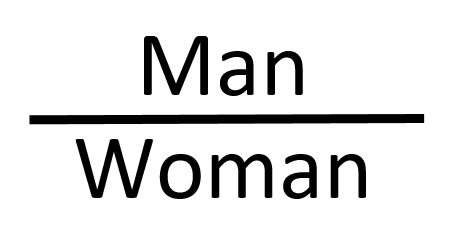
– then dualism, as Plumwood describes it, would look something more like this:
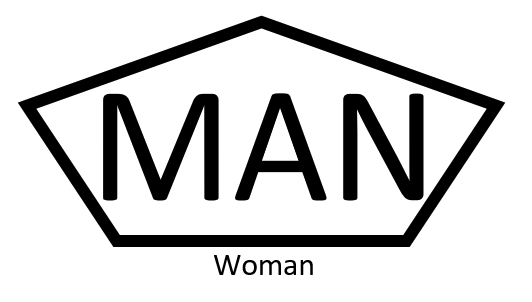
It is a relationship wherein one side is firmly centred, and the other (the ‘underside’) is kept in the background, kept underfoot, and conceived in terms of how it serves the purposes of the centre. Dualism, Plumwood argues, is essentially a way of taking and arranging existing differences: exaggerating them, mystifying them, and warping them in such as a way as to ground and naturalise relations of domination (Plumwood, 1993, p.55). Any difference can in principle be treated as a dualism, Plumwood argues, but in practice, dualisms arise in concert with power relations, and form the primary mechanism of their justification:
Dualism can also be seen as an alienated form of differentiation, in which power construes and constructs difference in terms of an alien and inferior realm. In random tyrannies, beings may be selected for oppression in arbitrary and random ways. But in systematised forms of power, power is normally institutionalised and ‘naturalised’ by latching onto existing forms of difference. Dualisms are not just free-floating systems of ideas; they are closely associated with domination and accumulation, and are their major cultural expressions and justifications. (Plumwood, 1993, p.42)
So it is not just that oppressive dualistic concepts exist, and oppression consists of the enactment of them. Dualistic construals arise concurrently with material inequalities, as a means of justifying and naturalising them, and those concepts simultaneously provide the conceptual backing for the further extension of those inequalities. A dualism is basically a dichotomy that’s been steroidally warped through a mutually-bolstering relationship with materially oppressive power structures (Plumwood, 1993, p.47). One of the effects of pervasive dualism, Plumwood argues, is that it makes a non-hierarchical recognition of the differences upon which they are built seem impossible. They make oppression seem the fault of the differences themselves, rather than what has been made of them. Plumwood insists that the non-hierarchical recognition of differences is possible; it just requires a hard-fought uprooting of dualistic thinking to do it.
Another key point of Plumwood’s is that dualisms hunt in packs: that the broader cultural matrix of dualisms is ineradicable from the composition and behaviour of any particular one. She argued that the history of Western thinking has been dominated by a network of oppressive dualisms, all of which mutually support and undergird each other (Plumwood, 1993, 41-44). Each dualised centre is defined oppositionally against not just a single other, but draws conceptual content from multiple spheres of exclusion. (i.e. ‘Man’ has been defined dualistically against ‘woman’, but also against ‘nature’; ‘civilisation’ has been defined dualistically against ‘nature’, but also against ‘barbarism’.) This interweaving, something like the links in chain-mail, makes the entire network stronger and harder to dismantle. Much of Plumwood’s work was devoted to the particular proposition that we have constructed the human/nature relationship as a dualism, and that the subjugation of nature provides crucial connective tissue to understand the linkages between other kinds of oppression. There isn’t time to do justice to the richness of that thesis and its implications here, but I believe that Plumwood’s conception of dualism – not only as a logical structure, but also as a “process in which power forms identity” – is a powerfully useful tool through which to understand the logic by which domination operates (Plumwood, 1993, p.32).
The structure of abusive relationships, I argue, bears all the hallmarks of dualism. Despite the immense variety and heterogeneity of abusers, it has been my experience that most survivors of intimate partner abuse who are presented with it find something of this basic relationship structure intuitively familiar:
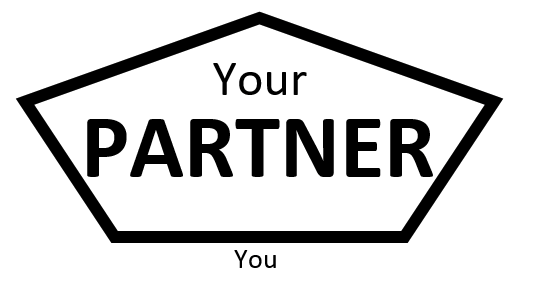
This schematic can be read in terms of ‘whose needs and feelings seem to matter more in the relationship’. It can be read in terms of ‘whose integrity is supported by being in the relationship, and whose is subordinated to it’. In abusive relationships, one partner’s integrity is bolstered by holding and exercising power over their partner, while the other’s integrity is undermined by being controlled and devalued. This can look many different ways, and relationships can assume this shape through a wide variety of different means, but on the most basic level, this is the structure. If a person is scared to assert themselves while their partner dictates terms, the schematic fits. If a person is centring their partner’s mental health at the cost of their own, the schematic fits. If a person is crushed by the labour of catering to their partner’s wants and needs while their own get shunted to the side, the schematic fits. Even while all of the superficial details of one abuser’s behaviour may be radically different from another’s, they all seem to be united in operating from this same basic, self‑centring, dualistic blueprint.
It is this blueprint, however implicit, that abusers punish their partners for deviating from. Abusers punish their partners for deviating from a self-centred and abusive idea of what a partner should be (being variously: a subordinate, an object, a servant, a punching‑bag, a yes‑man, a hollow extension of themselves with no independent existence, or some combination thereof). In light of the previous chapter, the notion that abusive behaviour is ‘self‑centred’ may seem somewhat obvious. My suggestion, however, is that it is the particular kind of self‑centring associated with the sort of complex subordinating treatments that Plumwood associates with dualism. In punishing their partner for deviating from their burgeoning dualistic construal of them, the function of intimate partner abuse is to coerce the structure of the relationship in line with that construal. Over time, the abuser’s violence bends the relationship into that dualistic shape. In this way, intimate partner abuse can be partly conceptualised as the externalisation (the ‘writing onto the relationship’) of a dualistic construal of an intimate partner.
As with the larger-scale dualisms Plumwood writes about, however, the process is not just a one‑way application of concepts. Dualisms build on already-existing inequalities, forming a feedback loop of justification and alienation. This is perhaps the basic reason why abuse nearly always gets worse over time. Once an abuser finds their partner subordinated even slightly, the mechanisms of dualistic thinking rationalise that inequality, which in turn justifies subordinating them further. This is also, I believe, the basic reason why men abuse more than women do. It is only a slight simplification to say that under patriarchy, women’s integrity comes ‘pre‑undermined’ by a social structure that pushes them to assume a subordinate role to men. Intimate relationships are not formed by units in a vacuum, and experiences of systemic marginalisation (whether on the basis of gender, class, race, or whatever else) powerfully influence the ‘starting point’ of integrity that a person brings to an intimate relationship, and how the individuals in it are primed to treat each other. There isn’t room to make this case with sufficient depth here, but a powerful tradition in feminist literature explores the breadth of sociocultural mechanisms – from narratives of romantic conquest to the material organisation of labour – through which “women are located and identified in a position of vulnerability to abuse, and men are located in a position to be able to be abusive” (Chang, 1996, p.64).[1]
My basic claim in this chapter is that intimate partner abuse is oppression writ small. All of the most important contours of the abusive mentality can be mapped, I claim, using Plumwood’s work on the logic of oppression. An abusive mentality allows a person in an intimate partnership to accomplish the following interlocking and complementary goals: (1) to take for granted what their partner does for them, and so not notice or care about what their partner suffers for them; (2) to believe their partner to be fundamentally different from them, in a way that justifies having differing sets of rules and obligations; (3) to override their partner’s autonomy and separateness from the abuser, so that they can make decisions on their partner’s behalf and supplant their partner’s independent existence; (4) to conceive of their partner primarily as a resource, so that they can take from them without having to give back; and (5) to simplify and dehumanise their partner, squeezing off the normal empathic safeguards that ought to prevent a person from systematically undermining the integrity of someone they are close to. Point by point, these are precisely the patterns of dualistic construal identified by Val Plumwood, enacted on an intimate scale. The result of these various mechanisms – the topline result of an abusive mentality – is that a person believes they are justified in treating their partner abusively, which allows them to gain without compunction all of the benefits that go along with being centred in their relationship.
As in dualism, abusiveness builds itself out of existing inequalities, and digs itself in deeper over time. As in dualism, each of the mechanisms of abusive thinking supports the development of the others, as they gain fresh justification from the very subordination they enact. As in dualism, abusive thinking justifies the use of regulatory violence to externalise an oppressive cognitive construal of an other into the structure of the social relation with that other. In the following section, I will go through each of the characteristics Plumwood identifies as dualistic, and detail some of the ways in which they each find enactment in intimate partner abuse. Not all of these traits are going to be present in every abusive situation, but they provide a framework for understanding the primary tracks down which abusive thinking runs. Taken together, these dualistic patterns of thinking characterise the mental schema by which abusers – to rework a remark of Marilyn Frye’s – contrive to not experience their partners as persons, so they aren’t as troubled by their failure to treat them as such (Frye, 1983, p.45).
1. Backgrounding
One of the characteristics Plumwood identifies as constituting dualism is backgrounding: the treating of an other as the backdrop against which the centre is the more important foreground. In the larger socio-historical terms Plumwood dealt in, the treatment of so-called ‘women’s work’ is a clear example. As Alice A. Kemp and countless other feminist theorists have pointed out, the entire lauded ‘foreground’ of Western history – of male explorers, of male achievements, of great men and their grand ideas – has only been made possible by the subjugated and invisibilised labour of women (Kemp, 1994, p.1-12). Some elements of this work remain widely unacknowledged as ‘real work’ even today (e.g. mothering, emotional support), while those others which have gained some measure of grudging and inconsistent pecuniary recognition (e.g. domestic labour, nursing) are still systematically underpaid and underappreciated. These forms of work have been crucial to the functioning of every society that has ever existed, and yet, in Marilyn Frye’s words, these “constant, repetitive, uneventful activities of women” have been cast only as the easily-ignored background against which “phallocratic reality is a foreground” (Frye, 1983, p.167).
For Plumwood, backgrounding accomplishes something crucial for the conceptual viability of oppression: it allows one to rely on something (for both material support and for one’s own conceptual definition) while simultaneously denying one’s dependence on it (Plumwood, 2002, p.24). When the relied-on other is backgrounded, this smooths out the tension that exists between these two goals. When the centre’s dependence on an other can be minimised and trivialised, then the centre can carry on using the background without threat to its own self-conception as independent and primary. Historically, Plumwood argues, men have backgrounded the women they have relied on, white colonisers have backgrounded the colonial subjects they have exploited, and humans have backgrounded the earth which sustains them (Plumwood, 1993, p.42-68). Backgrounding, almost like the stage‑managing of theatrical assets, devalues and flattens an other into the unacknowledged backdrop against which the drama of the centre unfolds. In this way, the centre ‘defines itself out of the background’ – able to depend on the background, while yet maintaining a claim of independence from the background.
In abusive relationships of nearly all kinds, backgrounding is a key dynamic. In some cases, this goes to the extent of fully approaching a master/servant relationship within the home.[2] But even in other abusive relationships that are more clouded and less obvious about it, the same essential dynamic persists.
All intimate relationships involve the negotiation of different sets of needs and wants, but in abusive relationships, one ‘side’ predominates. Abusers generally expect to be centred in the relationship: to have their needs matter more than their partner’s, to have their voice carry more weight in important decision-making, and to be thought of by their partner without having to think of their partner to the same degree. Through an abuser’s treatment of their partner, these expectations become habitualised into the structure of the relation, until an abused partner can feel (in the words of one abuse survivor interviewed by Abby Stein) like “wallpaper” in the relationship (Stein, 2014, p.33). Even when an abuser’s attention is firmly fixed on their partner, this isn’t a guarantee that backgrounding isn’t occurring. The more hagiographical locutions of abusers (e.g. “I love you, I need you, I’ll kill myself without you”) are only superficially focused on the partner; their practical effect is to keep the abuser’s wants and needs firmly in the centre of the sphere of concern. These abusive centre-background expectations allow a person to feel wronged whenever their partner steps out of line with those expectations, and contribute to the justification of punitive action when they do.
As a pattern of thinking, backgrounding accomplishes for an abuser something distinctly analogous to what it does for an oppressing class. It means that an abuser can depend on their partner’s labour, while simultaneously denying the significance of that labour. It is what allows an abusive husband to rely on his stay-at-home wife’s domestic work, for example, while simultaneously ignoring or demeaning that work.[3] What is behind the backgrounding here is nothing inherent to the work; it is just that the abuser is not doing it, and they have the power to structurally instantiate their disinterest in it. The same applies starkly to the work of managing emotions. The colossal amounts of energy that abused partners frequently put into managing the feelings of their partner – a task which can be virtually life‑consuming – are rarely acknowledged, because for the abuser, they just form part of the expected background.
2. Radical Exclusion
In Plumwood’s usage, radical exclusion refers to the tendency to maximise the conceptual distance between the dualised subject and the dualised object, in order to justify mistreating the latter. It is not enough that the two are distinct; their differences must be stretched and exaggerated until the two are seen as inhabiting radically different, alienated orders of being. “A major aim of dualistic construction is polarization,” Plumwood writes: “to maximize distance or separation between dualized spheres and to prevent them being seen as continuous or contiguous” (Plumwood, 2002, p.25). The centre does not want to be mistaken for the background, nor allow the background to leak into the centre. Continuity and overlap are thus written out of possibility, both in the construction of the relevant concepts as well as through the pressures, strictures, and regulatory violence of society’s structures.
The standard Western construction of sex and gender is something of a masterclass in the processes of radical exclusion. Physiological sexual difference is a spectrum with a wide range of variance and many fuzzy boundary-cases, and yet we have constructed sexual difference as a totally binary dichotomy, stigmatising and invisibilising human bodies that possess (as a not inconsiderable percentage of people everywhere do) a mix of conventionally uncorrelated sexual characteristics (Fausto-Sterling, 2000, p.1-29, 45-8). Even today, intersex children with perfectly functional genitalia are operated upon to give them genitals that appear more in line with the fiction of purely dyadic physical sex, despite how often this causes lifelong sterility, confusion, and pain (Davis, 2015, p.90-7). In order for gender oppression to function, the sexes need to be separated out as fully, clearly, and maximally as possible. Our entire cultural edifice of gender (everything from gender-segregated aisles in toy stores to gendered expectations of personality) extends this binary, further stretching the two realms apart and working to keep overlap and fluidity to a minimum. The maximisation and polarisation of these differences has long been a central component (often invoking the language of ‘innate nature’ or ‘biological capacity’) of the set of ideas used to justify the oppression of women.
In abusive relationships, radical exclusion is essentially the process of construing your partner as fundamentally different to youin ways that minimise, distort, and justify the abuse of them. It’s hard to treat someone with pervasive disrespect if you actively consider them the same kind of being as you, with the same expanse of interiority, the same range of needs, and the same set of rights. Because of this, abusers – in various ways, at first subtly, then increasingly over time – safeguard their ability to mistreat their partner by mentally construing them as a radically different kind of being to themselves, one for whom different rules and obligations are appropriate. Treatment that they would never accept for themselves gradually becomes standard for their partner, who is often made to believe that they are too inferior to warrant any better.[4] Bancroft describes the way in which abusers build conceptual walls between themselves and their partners, which over time can end up pushing their partner into an entirely different moral category in an abuser’s mind:
By depersonalizing his partner, the abuser protects himself from the natural human emotions of guilt and empathy, so that he can sleep at night with a clear conscience. He distances himself so far from her humanity that her feelings no longer count, or simply cease to exist. These walls tends to grow over time, so that after a few years in a relationship my clients can reach a point where they feel no more guilt over degrading or threatening their partners than you or I would feel after angrily kicking a stone in the driveway (Bancroft, 2002, p.63).
In an abusive construal, the partner is rendered as the kind of being who it is fine to abuse. This can either be because the abuser believes that their partner lacks real sensitivity to pain (like the stone in the driveway), or because the abuser believes they are oversensitive to pain (and so are making a fuss over that which they ought simply to endure). It can even – seemingly contradictorily – be both kinds of construal at once. As an abuser wonders with irritation why their partners seems to hurt all the time, they can conclude that the regularity of their partner’s pain (rather than saying anything at all about the consistency with which they inflict that pain) indicates that their partner never really hurts. In an astonishing contortion, an abuser can conclude that their partner hurts too much to actually hurt.
In the survey of testimonies from physically violent abusers compiled by sociologist James Ptacek, a startling number of the men volunteered some variation on the remark that “women bruise easily”. I have generally steered away from relying on the testimony of intimate partner abusers, for the simple reason that they are notoriously unreliable sources of information about their own abusiveness (Bancroft, 2002, p.15). At times, though, even their excuses and evasions can give away something significant. As Ptacek notes, this statement about women’s bruising “goes beyond an observation of comparative anatomy” (Ptacek, 1988, p.147). The statement gestures at an important strain of abusive thinking, which is the kind that is prepared to admit that, yes, they have made their partner bruise, but which attributes a minimisation of the significance of that fact to the internal characteristics of their partner. She is different from him, and it is because of this difference that she bruises. If she was different from who she is – better, perhaps more like themselves – she would not bruise. With this kind of degrading schema, it’s easy to see how this way of conceptualising her bruising can work for all the other kinds of harm an abuser can do to their partner too. All the fear and pain inflicted on a survivor of abuse is framed as just another kind of oversensitive “bruising easily”. In these abusers’ minds: she hurts, not because of what they do, but because of who she is.
In intimate partner abuse, radical exclusion can progress to a point of such active, contemptuous dehumanisation that an abuser can genuinely have a hard time believing that their partner even has a human experience of the world. As one survivor of intimate partner abuse testified, “Whenever I show him emotion, he thinks it’s fake” (The Dr. Phil Show, 2014). That same abuser repeatedly spat in her face, made her sleep on the floor when she was pregnant, degraded her with gendered and racial slurs, and refused point-blank to believe that the baby she was carrying could possibly be his.[5] Radical exclusion of this degree – seeing a partner as not even human enough to believe that their feelings are real – takes time to expand out from its subtler beginnings, but the ways it benefits an abuser are clear. When differences with a partner are maximised and warped (while similarities are minimised and trivialised), this construal “is important in eliminating identification and sympathy between members of the dominating class and the dominated”, and “helps to establish separate ‘natures’ which explain and justify widely differing privileges and fates” (Plumwood, 1993, p.49). Plumwood wrote the above about macro-scale oppressions, but it is quite precise in its application to abusive mentalities too.
3. Incorporation
Just as dualism maximises differences with the excluded other to justify their oppression, so too can it – paradoxically – maximise sameness to similar ends. Incorporation refers to this latter process: the assimilating of the dualised other, encountering them only in terms of the self, and encasing them into a relationship of asymmetric relational definition. Plumwood explains:
Because the other is defined and perceived in relation to the master, he or she is not encountered fully as an independent other, and the qualities attributed or perceived are those which reflect the master’s desires, needs and lacks. […] The other is recognised only to the extent that it is assimilated to the self, or incorporated into the self and its systems of desires and needs: only as colonised by the self. The master consciousness cannot tolerate unassimilated otherness. (Plumwood, 1993, p.52)
This dynamic of asymmetric relational definition – in which “she is defined and differentiated with reference to him and not he with reference to her” – is of course familiar from Simone de Beauvoir’s The Second Sex (de Beauvoir, 1949, p.8). A large part of the conceptual heritage of women’s oppression, de Beauvoir and countless others have argued, is the fundamental belief that men are primary and women secondary. In Genesis (2:7 – 2:23), man is created first, and then woman is created afterwards, to be his “helpmate”. As feminist commentators have long noted, when a couple is declared “man and wife” in the traditional formulation, the word ‘wife’ is linguistically dependent on ‘man’ for its meaning, but ‘man’ stands alone (Nye, 1989, p.174). This asymmetricality (“I define you, but you don’t define me”) is both an expression of power over the other and a mechanism for that power’s justification.
Beyond just asymmetric relationality, the key dynamic in incorporation is that the dualised other is recognised only for the ways in which it contributes to the identity of the centre. When an incorporating subject (or class, or civilisation) encounters an other, the qualities and differences of that other are experienced chiefly as lacks: lacks of the primary qualities possessed by the centre (Plumwood, 1993, p.52). To paraphrase Albert Memmi: the other is not recognised as actually having the full existence of the kind possessed by the centre, only a kind of shadow‑existence as the ‘not this, not that’ to the centre’s ‘this, that’ (Memmi, 1957, p.83-4). It is in this sense that the other can be said to be ‘incorporated’ into the dualised self: differences in the subordinated other are encountered only in such a way as to shore up the centre’s self‑conception. The endpoint of a logic of incorporation is that there are no legitimately different others, only failed selves. This has more or less been the attitude of all colonisers to the civilisations they encounter: that they are merely clumsy, backwards, childlike versions of the colonisers themselves, with the genuine differences of the other having been conceptually defused into something that only reinforces the self‑conception of the colonising centre.
In abusive mentalities, asymmetric relational definition can be seen (among other places) in the machinations of abusive men who cheat on their partners at disproportionate rates, but who simultaneously jealously control their interactions with other men (Bancroft, 2002, p.74). In the justificatory schemas of such men, their partner is defined by her obligations to him, but he is not defined by his obligations to her. Abusive incorporation sees the abused partner’s identity as wholly subsumed by the relationship, while the abuser’s identity is not equivalently subsumed. Many abusers will talk – often in passionately romantic language – about “becoming one” with their partners, but the implicit vision of this union is one in which their partner loses their independence and distinctness, while the abuser retains theirs (Penfold, 2006, p.37, 71, 149). Part of what happens is that an abuser comes to identify ‘the relationship’ so deeply with themselves – i.e. they see the relationship as being so wholly defined by their own needs and wants – that when they demand their partner sacrifice their identity ‘for the relationship’, that demand is functionally and cognitively indistinguishable from the demand that their partner sacrifice their identity for the abuser. At the deeper levels of abusive incorporation, a person with an abusive mentality can come to think of and treat their partner, not even as a fully separate person, but essentially as an extension of themselves. [6]
When a person thinks this way about their partner, it becomes trivial to make important decisions affecting their partner without them. It becomes habitual for the abuser to assume that they know and have the power to dictate – even over their partner’s objections – what their partner wants, what their partner believes, and what does and doesn’t constitute a violation of their boundaries. In an important sense, an incorporating construal sees an intimate partner as someone whose boundaries are not even real. “To invade another’s mind,” Patricia Evans notes, “doesn’t feel wrong if you do not recognize it as separate from your own” (Evans, 1993, p.153). Intimate partner abuse often involves a stark replication of the kind of dynamic that Elizabeth Spelman terms “boomerang perception”, and which Plumwood articulates as encountering a subordinated other “only as colonised by the self” (Spelman, 1988, p.12; Plumwood, 1993, p.52). Patricia Evans writes:
Each [partner in a relationship] must respect the other as a separate person. In an abusive relationship, this separateness is denied by the abuser. For example, if the partner of an abuser hears “You were” or “You are” or “You’re just” or “You should” or “You don’t” she is usually hearing this from a person who does not know that she exists as a separate person. Her own existence as a separate person is denied. In actual experience, only she can know if she “was”, “is”, “just”, “should” or “doesn’t” anything. Only she can define her reality and her experience. Anyone who presumes to do so violates her boundaries. (Evans, 1993, p.152)
Boundaries are a vital concept in human relationships. They are the places where we say: here is where you leave off, and I begin. Being abused by an intimate partner puts a person’s boundaries, both physical and psychological, under persistent attack.[7] To have one’s separateness denied by another – as happens when a person says “no”, for instance, and is told “you don’t mean that” – undermines that person’s integrity. These sorts of incidents can often feel small in isolation, but over time, they build up. What these incidents do (under the veil of passionate intimacy or paternalistic concern) is erode the fundamental separateness that is required for a person to be construed as a full human being. The function of incorporation in abusive mentalities is precisely what it is in macro-level dualisms: it allows the centre to conceptually neutralise the threat that a truly separate other represents. It ‘brings them in’, colonises them, and facilitates the abuser’s delusion that what the abuser wants is automatically what they and their partner together must want. This is the conceptual mechanism that allows an abuser to earnestly say “I just want what’s best for us,” while urging a plan that is transparently only best for themselves. Whatever is good for ‘me’, in this schema, is automatically good for ‘the relationship in which I am centred’. To an incorporating mindset, the word ‘us’ essentially means ‘me, with you absorbed and assimilated to my purposes’.
If this kind of conceptual ‘closeness’ seems at odds with the section on radical exclusion, that’s because it is. It is a distinctive feature of both abuse and oppression that these two processes – one maximising difference to justify mistreatment, the other maximising sameness to justify mistreatment – are able to co-exist. The ability to maintain this tension is one of the most distinctive hallmarks of dualism, and it can be found in the conceptual underpinnings of both large-scale oppressions as well as the most private ones. “You couldn’t be more disgustingly different from me; also there are no boundaries between you and me” is a bizarre set of propositions, but with enough structuring incidents – and enough undermining of the faculties capable of resisting them – an abused partner can be coerced into accepting the practical inferences of them.[8] The synergy of these devaluing strategies is both a conceptual underpinning of power-abuse and also, in a strange way, an expression of it. There is power, after all, in making someone believe your contradictions. If radical exclusion says, “You are different from me, so I get to control you,” incorporation says “You are just an extension of me, so I get to control you.” On one level they are hopelessly contradictory, but when it comes to their more fundamental purpose, they are perfectly in sync.
4. Instrumentalism
Through instrumentalism, a dualised other is conceived, not as an independent centre of needs and purposes, but as a resource to serve the needs and purposes of the centre. Plumwood writes:
The upperside is an end in itself, but the underside has no such intrinsic value, is not for‑itself but merely useful, a resource. The identity of the underside is constructed instrumentally, and the canons of virtue for a good wife, a good colonised, or a good worker are written in terms of usefulness to the centre. In the typical case this involves setting up a moral dualism, where the underside is not part of the sphere to be considered morally, but is either judged by a separate instrumental standard (as in the sexual double standard) or is seen as outside morality altogether, part of the realm of the “natural and expedient,” of usefulness to the centre. (Plumwood, 2002, p.28)
The point about the ‘canons of virtue’ is important. As Plumwood describes it, it is not only that the underside is treated as a resource; it is also that the identity of the underside is constructed around its role as resource – around what it can instrumentally provide to the centre and how faithfully it will do so. When we think about what a ‘good worker’ is under capitalism, or what a ‘good wife’ is under patriarchy, their essential criteria of virtue are foundationally built around what such people can provide to those with power over them. The same is true of most abusive mentalities, where abusers generally have an unrealistic and oppressive canon of virtue regarding how their partner ought to be. The abusive canon of ‘good partner’ (in terms of the standards of deference the abused partner is supposed to show cheerfully, the submission they’re supposed to give voluntarily, and the services they’re supposed to provide uncomplainingly) is only applied in one direction, and gets constructed into increasingly unreachable heights as the relationship wears on.[9] Ultimately, if an abused partner does anything but continually and impossibly offer themselves as an inexhaustible resource, they will be found in violation of that oppressive canon of virtue, and will find themselves in line for punishment because of it (Bancroft, 2002, p.56).
An instrumentalising mindset facilitates an abandonment of the logic of mutual exchange. Simply put: if ‘you are an object here for me to use’, then me using you is right and natural, no matter what you might have to say on the subject.[10] Plumwood argues that in the case of relating to the natural world, instrumentalism is more or less “the accepted and explicit Western model”; it is only when we have wanted to instrumentalise other humans that it has had to “take disguised and subtle forms” (Plumwood, 1993, p.147). Many of these subtler forms can be witnessed in the specific machinations of certain abusive manipulations, particularly those which frame their controlling behaviour as being for the abused partner’s own good, as being secretly desired by the abused partner, or as being part of a mutual complementarity that ultimately benefits both sides. Part of an instrumentalising construal, as Plumwood describes it, is the assumption that the dualised other has no (or few, or base, or unimportant) purposes of their own, and so the other represents a blank slate on which the centre can (‘graciously’) fill in that perceived emptiness with its own purposes.
Instrumentalism appears to be a powerful cognitive component in many of the most traumatising and terrifying manifestations of intimate partner violence. In a recent analysis of anonymous confessions of sexual violence, one self‑acknowledged rapist wrote of his mindset at the time, “She wasn’t a person anymore just a path, a tool, a means to an end” (Hipp, et al, 2015, p.5-6). Motivations for acts of sexual violence can vary, but every act of sexual violence implicitly involves at least this much of an instrumentalising calculus: ‘what I get from this outweighs whatever it may cost the person I do it to.’ Most abusers, of course, instrumentalise their partners for much more than just sex. Countless survivors of intimate partner abuse speak of feeling ‘sucked dry’ following long periods of their emotional and domestic labour being consumed but not reciprocated. Frequently disguised as the need to sacrifice in love, the calculus of abusive instrumentalism (‘I am entitled to take, you are obligated to give, and what I get automatically outweighs whatever it may cost you’) can come to define the terms of an entire relationship.
5. Homogenisation
The final characteristic of dualism Plumwood identified is homogenisation: the tendency to deny (or disregard, or run together as unimportant) differences within the subordinated sphere. The dualised centre tends not to be interested in diversity and multiplicity which does not serve it, and so enacts a systematic denial of recognition of that diversity. This manifests itself in stereotyping – i.e. the assumption that an individual will have the characteristics we assign to their group – but also in the more systematic flattening of diversity and multiplicity which is extraneous to the purposes of the centre. A contemporary example of this is the way in which, out of the hundreds of distinct peoples who lived on the Australian continent before it was colonised, white Australians generally continue to homogenise a single people: ‘aboriginals’ (Plumwood, 1993, p.53-4). When a dualised centre can construe a class of others as an undifferentiated collectivity, it becomes easier to shirk real recognition of those others, and to only engage with the centre’s own false and homogenous picture of them.
In the venue of intimate partner abuse, homogenisation operates as the denial or dismissal of the abused partner’s complexity, specificity, and inner life. On the group level, a heterosexual man who homogenises women in general – i.e. who believes that women are certain things and want certain things no matter what they say to the contrary, and who relies heavily on sexist cultural scripts for relating to them – will tend to encounter his partner not as the individual that she is, but as a more or less unsatisfactory reflection of those beliefs. Bancroft references the following common dynamic: an abusive man will tell a woman that she is nothing like all the other women he has been involved with, that she is the ‘one good one’ among a sea of harpies. No matter how hard a woman might work to remain outside the scope of his misogynistic homogenisation, such a dynamic almost invariably results in him turning on her, eventually homogenising her as “just like the rest of them” when she asserts her needs or boundaries in a way he finds unacceptable (Bancroft, 2002, p.115). In particular abusive situations, the claim that “you’re just like the rest of your awful family” can serve a similar purpose.
The individual level of homogenisation is subtler. Open misogyny often carries abusive behaviour in tow, but Bancroft is careful to stress that plenty of abusers possess the kinds of education and sensibility that make them abstain from such talk, or even espouse actively feminist politics (Bancroft, 2002, p.40-1, 88-91). On the individual level, the homogenising abuser has a whitewashed idea of who their partner is as a human being. Complexity in their partner’s psyche is denied, and contradictions (or even just emotions that are not straightforwardly pleasant) are either ignored or punished.[11] The partner is not recognised as a full human being so much as a vague, simplified notion of one. After an abused partner finds that “being spontaneous and open” leaves them vulnerable to punishment, they are likely to smooth out her own idiosyncrasies around their partner (Evans, 1992, p.52). When a person’s full self (their opinions, their feelings, their specificity) is met with regulatory violence, whether physical or non-physical, an abused partner becomes coerced into presenting a homogenised version of themselves to their abuser, just to get by.[12]
Abusive homogenisation can look like overt disrespect and dismissal, but it can also, significantly, look like idealisation: the kind of effusive “you are a perfect creature sent to me from God” sanctification that cannot help but misrepresent and homogenise a human being, and thereby set the stage for disappointment and, not infrequently, entitled retribution. Part of not being treated as a full human being is not being allowed to embody the kinds of growth, contradictions, and complexity that go along with being human (Bancroft, 2002, p.115-6). When an abusive partner, for instance, gets enraged at their partner for saying “no” to a particular sex act that they had consented to on a previous occasion, that abuser is expecting of their partner a level of consistency, predictability, and choicelessness that betrays a lack of recognition of their full personhood. This kind of construal works to undermine an abused partner’s integrity because it precludes recognition of who they really are, and justifies coercing them into acting the part of a simplified, homogenised version of themselves. After enough of this treatment, an abused partner can start to lose touch with what the non‑homogenised version of themselves is even like.
*
Not every abusive mentality involves all of these features, or manifests them in anything like equal proportion and prominence. Every abusive situation is distinct, and mediated in very specific ways by the individuals involved, the particular encouragements of their surrounding cultural context, and a great many other factors (Bancroft, 2002, p.76-7; Danis & Lockhart, 2010, p.xxiii-xxx). Even where the cognitive characteristics appear, they are not necessarily constant or reliable; rather, they are paths of thinking that the abuser can go down at certain moments, and steer away from at others. Over time, however, as the abuse continues, those paths get habitualised down into deeper and deeper ruts. Even mild abusiveness undermines the integrity over the person it is practiced on, and even mild abusiveness (if it is not challenged or halted) nearly always accretes into something more severe.
The seed of the desire to abuse is not so unrecognisable: if we have ever found ourselves saying something biting to someone because we felt slighted by them in some way, we have experienced it. What differentiates an abusive person from a nonabusive person, however, are the patterns of thinking which either cut off this seed or nurture it into something unmanageable. In an abusive mentality, perceived slights are more frequent (because anything that differs from their unfair expectations of their partner is experienced as a slight), and abusers consider themselves justified in punishing their partner for those slights. As they undermine and subordinate their partner, they rationalise the benefits they acquire through that subordination, and come to expect higher and higher standards of deference and control. The more they perceive their partner through the processes of dualistic construal, the more regulatory violence they consider justified to push the relationship into a dualistic shape. And the more unreasonable and controlling they become, the more they perceive their partner’s coerced deference as confirming their thinking.
One could make convoluted diagrams of these processes, but the topline result of them is fairly straightforward. The mechanisms of dualism, when applied to an intimate partner, justify and encourage employing various kinds of regulatory violence against them in order to keep them in what the abuser sees as their ‘proper place’. These patterns of thinking combine to form a dualistic cognitive structure through which the abused partner is encountered. Through the lens of that structure, what they do to their partner isn’t wrong, and isn’t even abuse. It is simply and intuitively appropriate treatment, given who each of the partners are, and what position they ought to occupy in the relationship. Once the entrenchment of this cognitive structure is deep enough, there’s almost no way to get an abuser to see their partner outside of it.
There are other works that go into the cognitive patterns of abusers in more granular detail than I have here (for example, the cognitive-behavioural manual Treating the Abusive Partner), but reading them, I always have the feeling that something important is missing. These texts are correct, for example, in identifying that abusive cognitions can involve “arbitrary inference/causal thinking” (the example Murphy and Eckhardt use is “My partner is wearing a new perfume, so she must be having an affair”), but they do not adequately account for the ways in which that arbitrary inference is targeted (Murphy & Eckhardt, 2005, p.205). Many abusers will indeed make absurd leaps of logic in their rush to blame and castigate their partner, but in the other areas of their lives, they are no more prone to arbitrary inference than anyone else. It therefore seems that there has to be something else operating ‘underneath’ that arbitrary inference: something about their construal of their partner which links the nodes of such patterns, and which singles out the abused partner for their special application.
Plumwood’s mechanisms of dualism, I argue, fill in all of these gaps. In the perfume example cited above, for example, the inference seems much less arbitrary if one adds the implicit premises: (1) ‘my partner is a despicable and untrustworthy person’, (2) ‘everything my partner does is about me in some way’, and (3) ‘I know my partner’s mind better than she does’. If one adds some of the partner‑specific cognitive processes of radical exclusion and incorporation, in other words, the surface‑level cognition about the perfume becomes a lot less mysterious. It is no more true or reasonable, but it is certainly less arbitrary. When the abused partner in that example wears that new perfume, the abuser feeds their own experience of that development through their habitualised dualistic thought-patterns concerning their partner, and what results is further justification for regulatory violence. In truth, you can feed almost anything into such a structure, and what will result is further justification for regulatory violence. This is its purpose, and it leads to outcomes desired by the abuser. Abuse is not ‘illogical’, strictly speaking; it just operates from the logic of oppression.
I am nowhere close to being the first one to point out the analogy between abuse and oppression. Lundy Bancroft calls partner abuse “intimate oppression” (Bancroft, 2002, p.321). bell hooks refers to it as “tyranny in the household” (hooks, 2002, p.167). Patricia Evans calls abuse “a relationship of oppressor to oppressed” (Evans, 1992, p.180). Some of the testimonials in Evans’ books are even blunter.[13] In a very practical and material sense, abuse and oppression support each other. It is easier for abusive men to practise their harms in a world with structural sexism, after all, just as it is easier for structural sexism to exist in a world in which so many women’s lives are consumed with dealing with intimate partner abuse. But oppression and abuse are also connected by a more subterranean kinship. They share a logical structure. They adopt the same outlook, use the same tricks, and chase the same basic relational ideal. They both, in the mutually applicable words of phenomenologist Sandra Bartky, “make the work of domination easier by breaking the spirit of the dominated” (Bartky, 1990, p.23).
The analogy between abuse and oppression is, I believe, a mutually enriching one. In one direction, it powerfully clarifies what is really at work in intimate partner abuse, piercing through the self‑serving distortions that abusers routinely deploy to obfuscate their motives. In the other direction, it may also clarify some of the more perplexing and contradictory dynamics of larger-scale oppressive structures. Oppression, like intimate partner abuse, is a system of regulatory violence, intended to coerce social relations into a particular shape. Like intimate partner abuse, its mechanisms are routinely obfuscated by distortions, evasions, and victim-blaming. Like intimate partner abuse, it profoundly undermines the integrity of those who are trapped in its machinations. One could take this analogy too far (abuse and oppression are not identical phenomena), but the underlying point is sound: both operate from the subordinating logic of dualism.
With the testimony of intimate partner abuse survivors analysed in the light of Plumwood’s conception of dualism, many of those machinations can be broadened and clarified. It is common for people to interpret the term ‘verbal abuse’ as simply implying ‘yelling’ or ‘fighting’, but based on the testimonies in books like Patricia Evans’, verbal abuse is more insightfully understood as the use of speech to subordinate someone into the position of dualised underside in a relationship. This can be done in a whisper, and even a whimper. In verbal abuse, words are used to background a partner, alienate them, incorporate them, instrumentalise them, and homogenise them over time. Physical abuse is the use of physical force to do the same. Financial abuse is the use of financial power to do the same. Each of the characteristics of dualistic construal, when enacted on a private scale between intimate partners, contributes to the erosion of the integrity of the partner who is subjected to them. Each of them works to centre the perpetrator of them in a dualistic relationship structure facilitated by that erosion. And each of them, crucially, supports the development of the others.[14]
Abuse is, first and foremost, a practice. It is something that, like loving, one chooses to do. But it is also rooted in particular patterns of construal, thinking, and justification. If we are to take seriously the idea that the practice of love can be productively thought of as the opposite of the practice of abuse, then a clear conception of the patterns and structures of abuse represents a clear guidepost of the way forward. I have introduced Val Plumwood’s conception of dualism (with its five attendant mechanisms) because I believe it helps us give us such a guidepost. Plumwood’s notion of dualism was not intended to be a totalising or reductionist idea of what oppression is, but rather an attempt to articulate the basic logic by which domination operates across its many and various forms. Plumwood’s conception of dualism is a way of codifying the observation that domination does not operate merely as a hierarchy, but rather as a much more complex and ongoing process of marginalising, excluding, assimilating, objectifying, and whitewashing. I claim that intimate partner abuse – when understood with clear eyes, with the abuser’s evasions and justifications carefully excised – involves precisely these same cognitive patterns, externalised on an intimate scale.
I claim that abuse is rooted in, and an enactment of, the logic of oppression. This statement, although true, is certainly not simple. Intimate partner abuse is generally not oppressive in the way that a simple and clearly‑established hierarchy is oppressive. Rather, it is oppressive in the way that oppression actually is: exhaustingly complex, multi-faceted, confusing, inconsistent, and continually misrepresenting itself. It snares a person into tangles, and slowly strips them of precisely those faculties needed to untangle themselves. It rigs a relationship into a losing game, which it then blames the other side for losing. It is not easy to find the opposite of such a knotted web, but I believe that the clarity of Plumwood’s formulations makes the task easier. Through all the smoke and misdirection, clarity is possible. Through the guidepost of its opposite, domination can be unwoven. In the following chapter, I will – finally – start to talk about love.
[1] Any attempt to summarise this literature here will be unsatisfactory, but if I had more space, I would particularly want to discuss the valuable work that has been done in feminist attachment theory, largely in the wake of Jessica Benjamin’s landmark The Bonds of Love (1988). Benjamin traces the psychoanalytic roots of domination into the disruption of the development of healthy mutual recognition in the earliest gendered attachments of a child’s life. When asking the question “Why do men abuse more than women?”, the short answer is “patriarchy”, but the way in which this actually plays out – in cultural norms, in material inequality, even in the psychological development of infants – is extraordinarily complex.
[2] “When he isn’t being out rightly abusive, he ignores me like a hired housekeeper” – D.M. from Hampton (Evans, 1993, p.126).
[3] “Of course,” Bancroft writes of such situations, “if he attempts to do what she does – for example, if he is the primary parent for a while because he’s unemployed and she’s working – he does an abrupt about-face: Suddenly he declares that parenting and housekeeping are monumental and admirable tasks, requiring hours a day of rest for him to recuperate” (Bancroft, 2002, p.56).
[4] “I was yelled at, insulted, humiliated. I was made to believe I was stupid, I was constantly criticized, I was made to feel inadequate and inferior.” – J.B. from New York (Evans, 1993, p.72).
[5] This last belief has appeared a surprising number of times in my reading; it seems a common manifestation of severe abusive exclusion in situations where the abused partner is pregnant (e.g. Roberts & Shenkman Roberts, 2005, p.34). One of these survivors testified, “When I was pregnant, he hit me a bunch of times in the chest, and I said, “I’m pregnant what are you doing?” He said, “It doesn’t matter it’s not mine,” and he knew I hadn’t slept with anyone else. And then he threatened to kill me and put me six feet underground” (McDonald-Harker, 2016, p.56).
[6] “At counselling I told my feelings from my deepest inner self; my husband exploded, how dare I feel these things! When I was laid off from a job I loved he said, “Admit it, you really are glad you don’t have to work. I know you are.” It was then that I started to realize that my own feelings, thoughts and emotions were never realized by him. As far as he was concerned, I was simply his extension.” – M.W. from Long Island (Evans, 1993, p.111).
[7] “The abuse increases as I set boundaries.” – G.S. from Tulsa (Evans, 1993, p.121).
[8] This tension can create insoluble binds for abused partners. Imagine, for example, that you’re wondering whether you should ask your partner if they’d like to come to an event based on your interests. The prior patterns of radical exclusion in the relationship would suggest ‘no’ – that they’ll be annoyed that you’d even imagine they could be interested in your dumb hobbies – while the prior patterns of incorporation in the relationship would suggest ‘yes’: that they’ll be angry if you decide to exclude them. This is a double-bind. Neither option is ‘right’, because whatever the abused partner does, the abuser will interpret it according to the mechanism that sees it in the worst light.
[9] “I have tried for so long to be a better wife, better homemaker, better cook, better lover, better looking, thinner, etc. and the list goes on and on. Despite all my attempts at being better our relationship has just gotten worse.” – I.W. from Oakland (Evans, 1993, p.132-133).
[10] “I was a thing, an object, he was totally indifferent to my needs . . . He was just as indifferent to his children unless they were waiting on him.” – E.W. from St. Louis (Evans, 1993, p.96).
[11] “My feelings didn’t count; if I cried, that was it, he left. I was allowed to be happy, but I wasn’t allowed to be sad, or upset, or cry” (Chang, 1996, p.82).
[12] “I was on guard, because he’d run down angrily my opinions and belittle them. “You don’t know what you’re talking about.” I seldom expressed my feelings and said only what I felt he wanted to hear” – Anonymous from Memphis (Evans, 1993, p.116).
[13] “He was the King. I was the serf.” – S.B. from Indianapolis (Evans, 1993, p.129).
[14] All of the characteristics I have discussed underlie actions which erode the integrity of an abused partner. At the same time, each of these characteristics is specifically aided and lent justification by encountering a partner whose integrity has already been eroded. In this way, abusiveness is able to accrue on itself, in an encroaching network of interwoven and habitualised cognitions, as the classic dualistic feedback loops grow and expand upon the territory they take.
 ada connor